

Higher Aarburg elevation and the 1754 survey plan
In Aarburg, there are two phenomena or sites that are important in the context of the Swiss national survey. The key element today is the control point group AG 471–476 of the national levelling network, which is spread out around the church and consists of a total of six points. These control points were established over 100 years ago and are still maintained today.
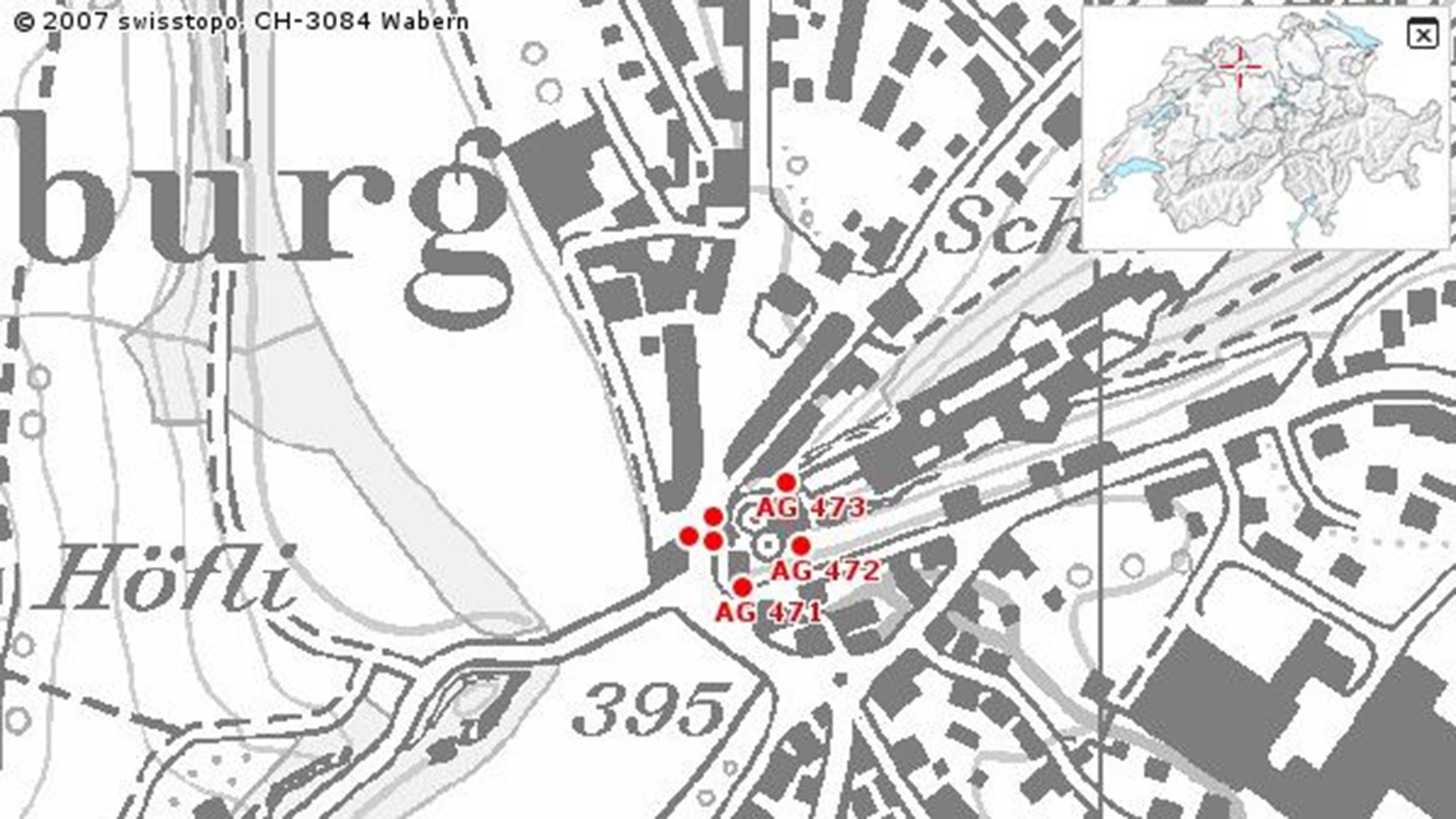
Elevation control point, Aarburg
During the investigations into how the Swiss elevation levels were changing over time, it became clear in the 1970s and 1980s that the Alps were still growing at a rate of about 1 mm per year in relation to the Swiss Plateau. The group of elevation control points in Aarburg proved to be representative of the Swiss Plateau’s elevation stability in comparison to the Alps. Thus, it had the same role for vertical movements in Switzerland as the rock known as the Pierre du Niton in Geneva harbour for sea level.
The second significant event in the history of surveying connected with Aarburg took place in the summer of 1754 when on 26 June, the Geneva physicist and geodesist Jacques-Barthélemy Micheli du Crest (1690-1766), who was the longest serving political prisoner in Switzerland in the fortress “laboratory”, drafted a comprehensive ground-breaking plan for the surveying of Switzerland. This proposed a two-part process in the form of a national survey (base line measurements, triangulation grid, topographic map-making in smaller scales) and a detailed survey with large-scale drawings.
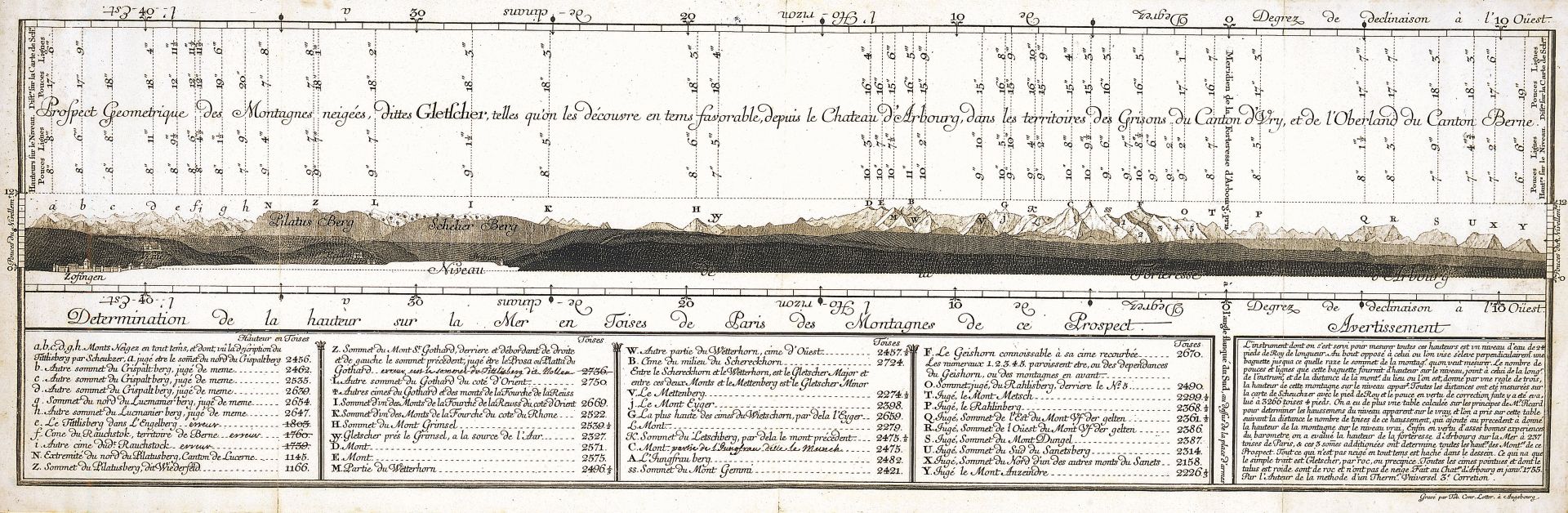
However, due to the fact this proposal came from a prisoner of the state, it disappeared into a functionary’s drawer in Bern and more than 80 years would pass before Dufour set up the Bureau topographique fédéral in Geneva. Micheli, however, was not discouraged and in the autumn of 1754, he produced the “Prospect géométrique des Montagnes neigées”, which has gone down in literature as the oldest scientific panorama of the Alps.
Federal Office of Topography swisstopo
Seftigenstrasse 264
3084 Wabern