

Beyond national borders
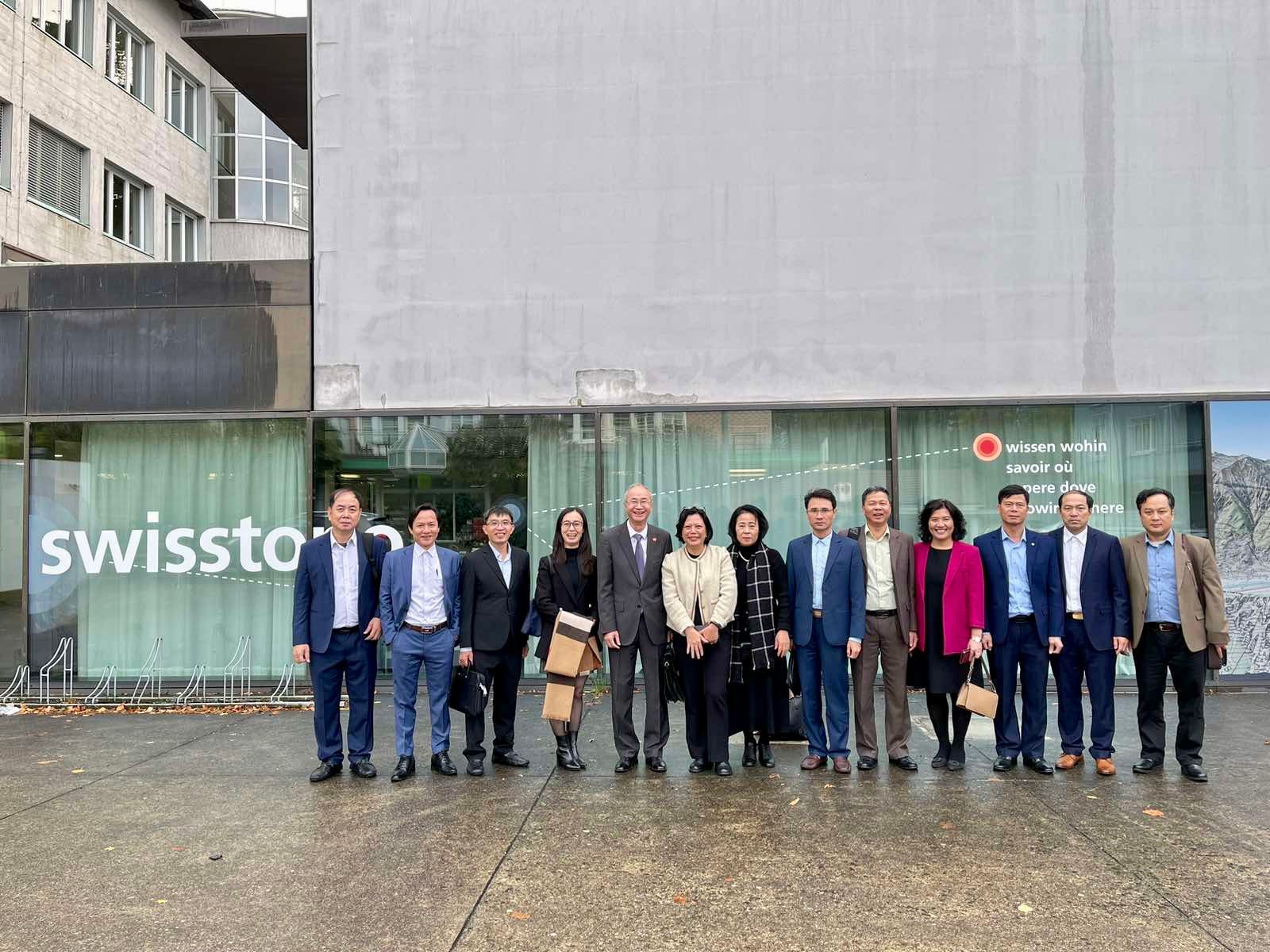
In November 2023, swisstopo opened its doors to the Vice Chairwoman of the National Boundary Commission at the Ministry of Foreign Affairs of Viet Nam. Mrs Nguyen Thi Huong was accompanied by a delegation of specialists in border issues. Interview.
Why did you arrange a working session with the Federal Office of Topography swisstopo during your visit in Switzerland?
Viet Nam is a country with a total land area exceeding 330,000 km2 and a sea area of about 1,000,000km2. Viet Nam’s land border spans over 5,000km long, sharing boundaries with the People’s Republic of China to the North, the Lao People’s Democratic Republic to the West, and the Kingdom of Cambodia to the Southwest. Over the years, Viet Nam has gradually engaged in exchanges and negotiations for the planning, demarcation, and marking of land border with its neighboring countries. Currently, Viet Nam and its neighbors prioritize promotion of border management along with development cooperation in border regions.
Through various mass media, we have learned that Switzerland has long harnessed advanced technology and applied scientific and technological advancements in border management. Switzerland has also implemented numerous collaborative initiatives with its neighboring countries to foster socio-economic development in border regions. We are eager to gain insights and knowledge from those experiences, with a specific focus on cooperation methods related to infrastructure construction and management within border regions as well as the cross-border cooperation models employed by Switzerland and its neighbors. This is helpful for our us to research and consider application of these approaches in border management and development cooperation initiatives in Viet Nam’s border regions.
What did you learn from this working session and what findings will you take back with you?
We see that the work of the Federal Office of Topography (Swisstopo) shares certain similarities with the tasks of our National Border Commission. Both are the authorities in charge of overseeing the management, inspection and preservation of the stability and clarity of the border system and boundary markers. We are also responsible for exchanges and coordination with neighboring countries in repairing, restoring, and protecting elements related to borderline and boundary marker systems. We are particularly impressed with Switzerland’s extensive network of boundary markers and border delineation which ensure clear and easy recognition of the borderline’s position on the ground. Furthermore, they are stored and managed by use of modern technology, thereby facilitating convenient exploitation and ultilization, especially data on boundary coordinates and synchronized border maps within the national geographic information system. This network employs a unified geodetic reference system across all of Europe.
We appreciate Swisstopo’s exchange and coordination mechanism with neighboring countries in measuring, inspecting and surveying terrain conducted periodically or on an ad-hoc basis to monitor and evaluate the stability or fluctuations of the border markers’ system and the terrain where the border passes. This is indeed a useful and highly relevant subject for us to research. In addition, the national geographic information database system built and managed by Swisstopo, which integrates various fields of Switzerland’s life, economy, and society, is also an interesting area that we can learn from in order to develop a similar database focused on Viet Nam’s territorial borders.
Along with the topics discussed and shared by Swisstopo, during our visit, we also had the opportunity to visit and discuss with Infobest Palmrain center and Geneva airport management authority. Our border localities are profoundly impressed with the conversations and development cooperation models in Switzerland’s border areas with neighboring countries. The insights shared regarding Infobest Palmrain’s work are highly benefical for our border localities in supporting and serving residents on cross-border issues, such as labour, employment, education and tax. Additionally, the cooperation between Switzerland and France in managment and operation at Geneva Airport within the border area has provided us with invaluable knowledge and stimulated contemplation on a practical and efficient collaboration model. This model, built upon mutual trust between neighboring countries, strives to bolster prosperity for the people within the border region of both nations.
What are your personal experiences concerning negotiations on border issues with neighbouring countries?
Territorial and boundary issues are always a sacred and vital issue for every country and people. National boundaries issues are often very diverse, and involve functions and tasks of various ministries and authorities, and constitue unique characteristics of border localities. Therefore, in my opinion, during exchanges and negotiations with neighboring countries, officials working on border affairs need to pay attention to a number of issues as follows:
First, territorial and boundary negotiations cannot be conducted in isolation from the broader global and regional contexts, as well as the current state of relations with neighboring countries. Negotiators must possess a firm grasp of negotiation objectives and work in a high sense of responsibility to achieve outcomes in accordance with international law and treaty.
Second, it is essential to have an in-depth understanding of legal, technical, and historical aspects pertinent to the negotiations. Additionally, it is also crucial to reach a concensus on negotiations with other participants representing various ministries, authorities, and border localities. Negotiators must maintain a good health to be ready for prolonged and stressful negotiations.
Third, during territorial and boundary negotiations, it is unavoidable that both sides may have different perceptions on some issues. In such cases, all parties concerned must uphold pre-established principles and agreements, and engage in discussions and negotiations in a spirit of goodwill and cooperation. Once a clear understanding of each other's stance is established, it would be easier to find common ground and arrive at equitable and reasonable solutions aligned with international law and acceptable to all parties involved.
I have already participated in and led numerous border negotiations with neighboring countries. Therefore, I am mindful that this is a truly demanding and intricate task. The negotiator, once engaged in negotiations, regardless of man or woman, will steadfastly safeguard the interests of their nation and people. I believe that the chief negotiator, in addition to having unwavering determination and persistence, must have the ability to be tender and agile to ensure negotiation’s right direction and attain deliverables for their national best interests.
There were several women in your delegation. How do you foster equality between women and men within your organisation?
At the National Border Commission - Ministry of Foreign Affairs of Viet Nam, women makes up for approximately 40% of the total number of employees. In recent years, the Ministry of Foreign Affairs has always paid due attention to and created favourable settings for women to have greater educational opportunities and hold more important positions in leadership and management. I think we can learn from the following experiences:
First, leaders at all levels and women themselves must have a clear understanding of gender equality, and its relevance to their work. This enables them to recommend initiatives and policies for promotion of gender equality.
Second, it’s essential to realize the state's guidelines and policies on gender equality through integrating gender equality into the recruitment and training stages. This includes facilitating participation of woman officers in all aspects of work and prioritizing their attendance in training programs that enhance leadership and management skills, ensuring their professional growth.
Third, according to Asian beliefs, women not only participate in office work but also have to raise their children and do houseworks. This is a very difficult task to fulfill. In Viet Nam, in addition to specific support programs and policies for woman officers and United Nations programs to promote gender equality, we also benefit from the attention and support of the leadership at all levels and fellow colleagues in workplace. This helps women leverage their ability while simultaneously nurturing a happy family life.
Currently, the ratio of women in the leadership at the National Boundary Commission is nearly 30%. I am the first Vice Chairwoman of the Commission since its establishment in 1975. This is a truly remarkable achievement, reflecting the collective efforts from both the organization and each individual, especially woman officers. In the coming time, we will continue to create favourable conditions, foster and provide new opportunities for women, not only to train the next generation of woman leaders, but also for each woman officer to have access to opportunities for individual development, education, and enjoy happiness in both their professional and personal lives.
Federal Office of Topography swisstopo
Seftigenstrasse 264
3084 Wabern