

The meridian sighting marks of the Neuchâtel Observatory
From 1859 to 1959, to determine Swiss time the Neuchâtel Observatory observed the passage of the stars above the meridian using a telescope. To make sure that the telescope was correctly adjusted, it was required to scan the north-south axis and identify two marks serving as reference points. These marks still exist today. The southern mark in Portalban has a direct link to swisstopo since it was integrated into the national survey network.
What is a meridian sighting mark?
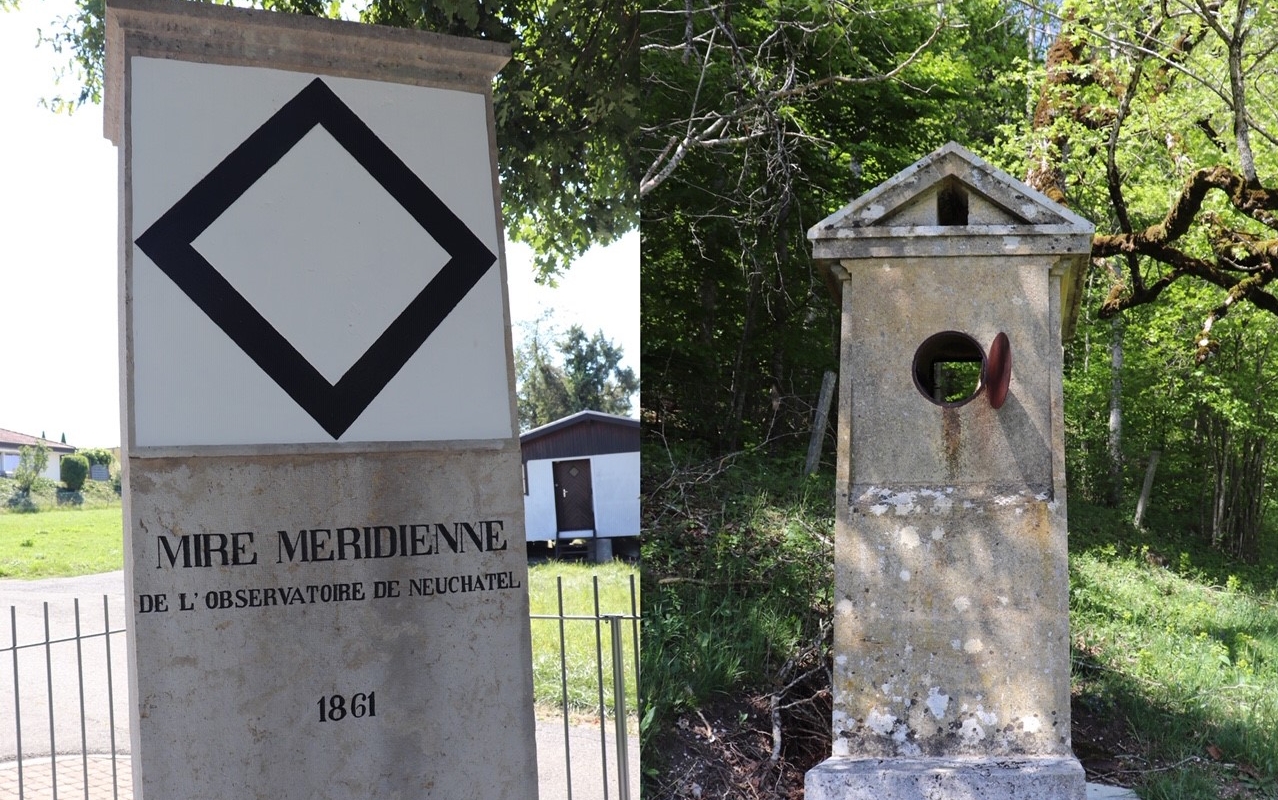
It is a stone construction which had to be visible with the meridian telescope. In order to enable the Neuchâtel Observatory to cover the north-south axis and thus determine the time at which the stars pass over the meridian, two telescopes had to be built. One to the north and the other to the south. If the telescope did not detect these marks, they had to be readjusted.
In 1959, the meridian bezel was abandoned and replaced by a new type of instrument, the PZT bezel for "Photographic Zenithal Tube". The meridian sighting marks are no longer useful for this new instrument. However, they are now part of the heritage of the Neuchâtel Observatory and swisstopo.
Where are these marks?
The Observatory of Neuchâtel had three sighting marks built. The closest was on the Mail hill, 80 meters from the Observatory. It no longer exists today. The northern sighting mark was erected in Chaumont, 3 kilometres from the Observatory. The third was built in Portalban, on the shores of Lake Neuchâtel, 9.5 kilometres south of the Observatory. Like the mark in Chaumont, the Portalban sighting mark still exists
The southern sighting mark in Portalban
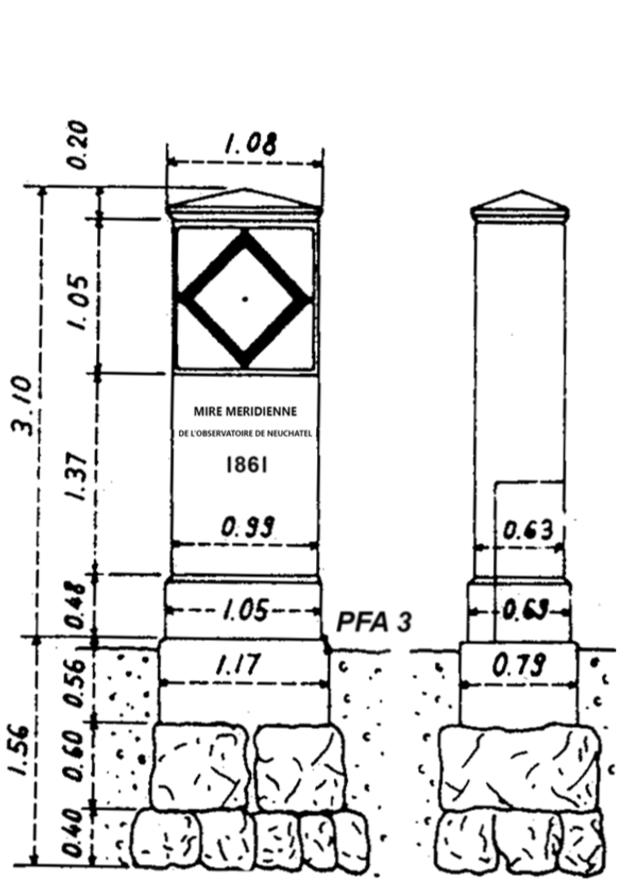
The first mark in Portalban was rather crude. Indeed, in 1861, the Observatory had a black diamond painted on a rock on a white background. The second version of the mark was also created in 1861 and consisted of an obelisk 3.10 meters high. A white diamond surrounded by black was also painted on the stone structure.
The link between the Portalban sighting mark and swisstopo
In 1927, the Portalban sighting mark was integrated as a first-order fixed triangulation point and as a third-order triangulation point by the Federal Topographic Service (swisstopo). This fixed point was therefore measured precisely, and its coordinates are well known. As a result, the point is protected by federal law and cannot be dismantled. In 1886, a levelling pin was sealed on the sighting mark. swisstopo is responsible for its inspection and renovation. And its condition is checked every 12 years.
The renovation of the Portalban sighting mark
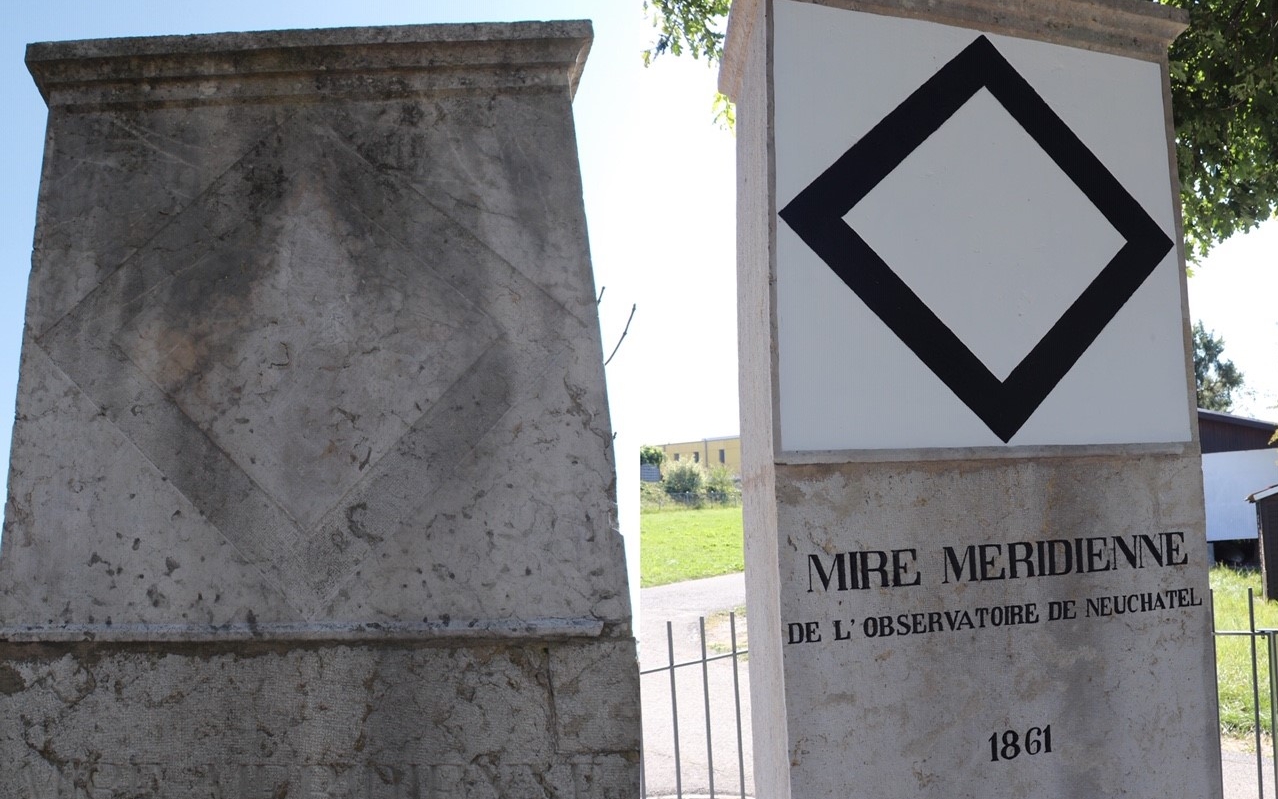
Together with the association EspaceTemps, swisstopo has given Portalban's sighting mark a second lease on life. A nearby tree was pruned and the barrier surrounding the mark was renovated. Old tree stumps around the mark were removed and the foundations of the sighting mark were reinforced. In addition, the mark was cleaned, and its black and white diamond was repainted. A commemorative and informative plaque was also installed.
The northern sighting mark in Chaumont
Built in 1884, the stone construction contained an opening to accommodate a kerosene lamp, visible at night from the Observatory. A white circle was painted around the opening to improve its visibility during the day.
Where are the sighting marks on the map?
On map.geo.admin.ch, only the Portalban southern sighting mark is visible because it is a first-category fixed triangulation point.
The coordinates of the two test patterns
If you want to go in search of the two meridian sighting marks, here are their coordinates:
Southern sight in Portalban: 2 563 065/1 196 137, 462.4 m
Northern sight in Chaumont: 2 563 149/ 1 208 200, 1036.3 m
Additional information
Federal Office of Topography swisstopo
Seftigenstrasse 264
3084 Wabern