

Transportation Network CH
With Transportation Network CH, users will in future be able to combine spatial mobility data in a highly automated manner for the first time – even across national borders. These combinations will allow them to obtain completely new information and use it to design applications that were previously impossible. Transportation Network CH thus makes a significant contribution to more efficient mobility in Switzerland.

What is the purpose of Transportation Network CH?
The aim is for Switzerland’s mobility system to become more flexible, smarter and more sustainable. There is still great potential here. In order to make the most of this, a reliable data basis is needed. A large amount of data on mobility and transport infrastructure is already available – however, this data is in different locations and is usually difficult or impossible to link. To make better use of it, the Swiss federal government is working on a national mobility data infrastructure (MODI).
The aim of MODI is to make the information about the Swiss mobility system more accessible and to link data more effectively (or link it in the first place). In future, this will enable mobility services to be increasingly optimised using data, and infrastructures to be utilised and planned more efficiently. As an important part of the MODI, Transportation Network CH will be used to link spatial data.
What exactly is possible with Transportation Network CH?
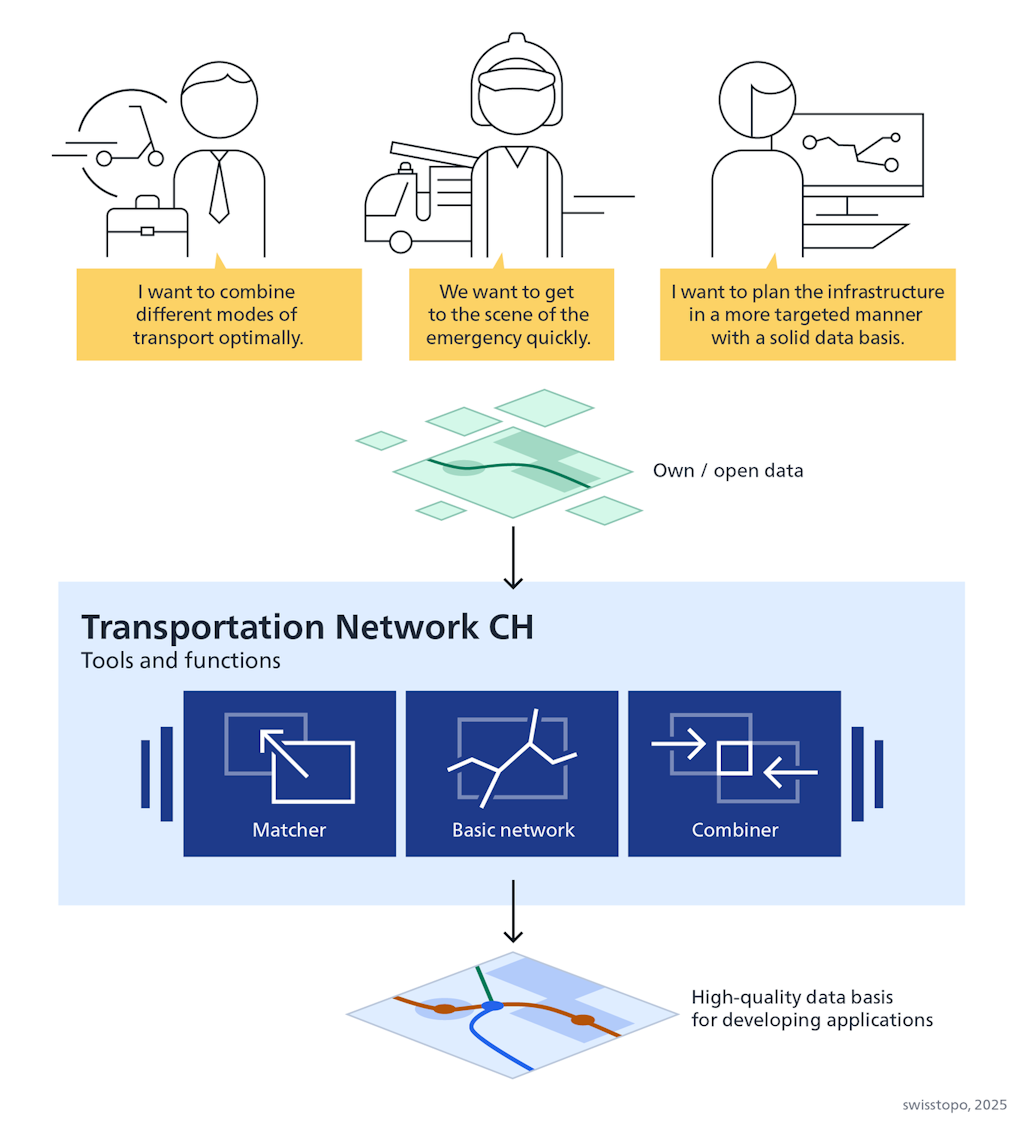
Transportation Network CH includes tools and functions that will enable users to link spatial mobility data in a highly automated manner in the future. In doing so, they will be able to combine both their own data and freely accessible data from third parties.
Index
Transportation Network CH in detail

How does Transportation Network CH work?
Details on data combinations, specialised Networks and the basic Network

Tools and functions
Tools for adding and combining transport network data

Examples of best practices
Already implemented and possible future applications of Transportation Network CH
What benefits does Transportation Network CH create?
New combinations of existing data form an important basis for the efficient planning and management of the transport infrastructure as well as for innovative applications and services in the mobility and transport sector. This benefits the public sector, business and society:
What has been achieved so far?
About the project
Who is behind the project and what approach did the team take?
FAQ
The most frequently asked questions about Transportation Network CH and the answers to them
Contact and further information
Federal Office of Topography swisstopo
Seftigenstrasse 264
3084 Wabern
If you are interested in Transportation Network CH, have specific questions about its use, would like to provide feedback, or have ideas for a specific application, please contact our project team: