Rapid Mapping is a federal government service that collects and makes available geodata such as aerial or satellite imagery following natural disasters, in order to document these events and in certain cases to manage it. The relevant authorities at all federal levels (federal government, cantons, communes) are actively supported in assessing and documenting the impacts of natural events.
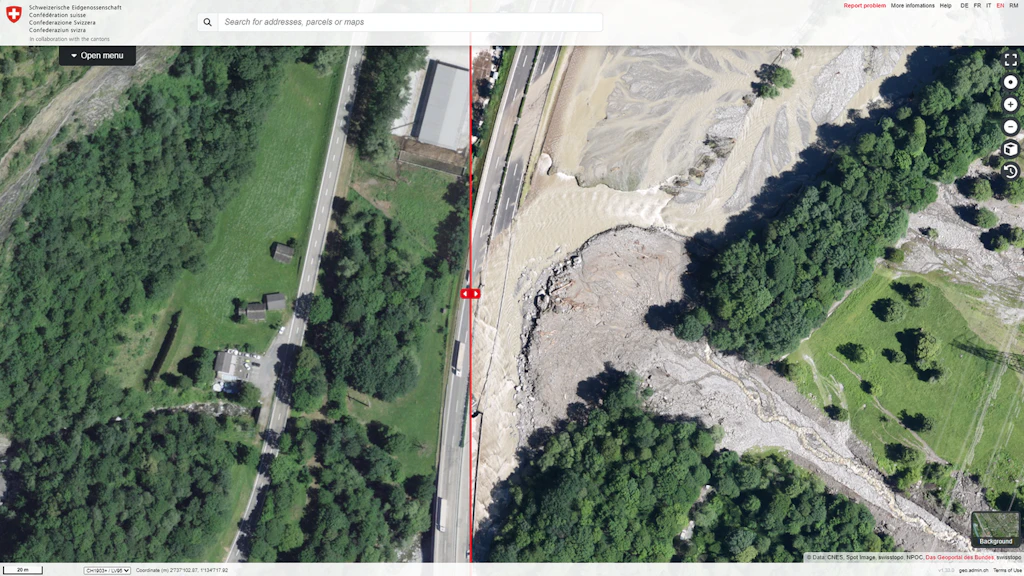
Print screenshot from the federal geodata portal of Misox in 2024: comparison before and after the event
Rapid Mapping collects and makes available geodata for the following natural events:
Flooding/Debris flows
Landslides
Rock avalanches/Rockslides
Glacier collapse
Avalanches
Storms
Forest fires
Drought
Earthquakes
The data is used to document, and in some cases to manage, the event.
Cooperation between authorities
In case of large-scale or nationally significant events, the Federal Office for the Environment (FOEN), together with the National Emergency Operations Centre (NEOC), coordinates the requirements of federal offices and cantonal agencies as well as any other stakeholders. Based on the requests received, the FOEN decides whether or not to deploy Rapid Mapping. If so, it instructs the Federal Office of Topography swisstopo to provide the data.
swisstopo obtains the required image data and makes the processed data available as Rapid Mapping products. In addition to the newly recorded (post-disaster) data, swisstopo also supplies the periodically updated basic geodata (pre-disaster) as a basis for comparison. Detailed information about the service can be found in the “Factsheet Rapid Mapping” below.
Rapid Mapping products and data access
Rapid Mapping produces single images and orthophotos of the required quality. Timeframe and weather conditions can additionally influence the quality of the images. The Rapid Mapping products can be viewed freely on at map.geo.admin.ch.
Products
Rapid Mapping offers a range of so called basic products. These include digital image data from various platforms (e.g. satellites, aeroplanes or helicopters) and sensors, chosen according to the nature of the request and equipment availability. The following basic products are defined:
Single images (oblique or vertical): quickly available, minimal geolocation. Main purpose: general overview
Quick Orthophoto: quickly available, compromises in terms of accuracy and aesthetics. Main purpose: event management
Orthophoto: fully processed orthophoto, time-consuming to produce. Main purpose: event documentation
Some or all of the basic products may be requested, as required.
A detailed description of the products can be found in the document “Rapid Mapping products swisstopo” below.
As always with aerial and satellite imagery, there are constraints that make it impossible to guarantee Rapid Mapping products within a specific timeframe. These include weather conditions and the availability of particular equipment at the time of the event. That said, all parties involved make every effort to ensure that the required products are available on time.
Data access
Access to Rapid Mapping products takes place via the Federal Spatial Data Infrastructure (FSDI). The products can be viewed freely on map.geo.admin.ch (pre- and post-disaster), making it easy for even inexperienced geodata users to visualise and compare the situation before and after the event.
Access to Rapid Mapping products is provided through the “ch.swisstopo.spezialbefliegungen” collection; items with the prefix “ram-” in the FSDI's STAC interface:
Datasets with many files: For single images and other large datasets, a CSV file containing the download links for all files is available. Please download the data according to the instructions in the section "Obtaining large datasets with spatial subdivision".
Files larger than 50 GB: Files larger than 50 GB cannot be downloaded using a standard browser download. Please download these files according to the instructions in "Downloading Large Assets (> 50 GB)".
Terms of Use
The conditions of use allow free use for all purposes and oblige the user to indicate the source as “Source: Federal Office of the Environment FOEN and Federal Office of Topography swisstopo” or “Source: FOEN, swisstopo”
Requesting Rapid Mapping
Rapid Mapping is a service for federal and cantonal management bodies and agencies with responsibility for natural hazards. Rapid Mapping requests are collected by the cantonal agencies with responsibility for natural hazards and forwarded to the Federal Office for the Environment (FOEN).
Rapid Mapping requirement notification: SPOC (On-call service 24h/365d) via the document below:
Rapid Mapping is available to any party that has a public role to perform in the event of a natural disaster. This applies, first and foremost, to the federal and cantonal agencies with responsibility for natural hazards, and secondly to the corresponding management bodies. The primary purpose of Rapid Mapping products is to document the event. Where appropriate, they may also be used to manage the event, from the rehabilitation phase onwards.
How is a need for Rapid Mapping products reported?
The needs of all cantonal, regional or local authorities are collected by the cantonal agencies with responsibility for natural hazards. They are the central collection points at cantonal level and relay the needs to the FOEN. Needs can be reported to the relevant FOEN portal using the “Request for Rapid Mapping products” form, available via the link above. This portal is available 24 hours a day, 365 days a year.
Past deployments
On May 28, 2025, a major rockslide occurred at the Kleines Nesthorn above Blatten in the Lötschental. Approximately 3 million cubic meters of rock, debris, and ice cascaded into the valley. The village of Blatten was largely destroyed, and the Lonza River was dammed. The population had been evacuated beforehand.
To document the event and as a basis for managing its aftermath, swisstopo conducted aerial surveys of the area.
On April 14, 2024, a major landslide occurred at Piz Scerscen in the Bernina Massif GR. Approximately one million cubic meters of rock and ice collapsed, covering the Val Roseg over a distance of more than five kilometers. There were no injuries. Several hiking trails leading to mountain huts and glacier crossings were affected.
Note: This did not constitute an official rapid-mapping mission.
On June 21, 2024, a stationary thunderstorm line formed over the Valle Mesolcina. The heavy rainfall triggered mudslides and flooding throughout the valley. In Sorte (municipality of Lostallo GR), a mudslide destroyed several houses. Two people lost their lives, one is still missing. Near Soazza GR, a mudslide forced the Moesa River out of its bed, causing the river to wash away a 200-meter stretch of the A13 highway. The north-south corridor over the San Bernardino Pass remained closed for two weeks.
A rapid mapping operation was launched to document and manage this event. Aerial surveys were conducted on June 22, 2024 (helicopter) and June 28, 2024 (airplane).
Heavy rainfall interspersed with thunderstorms caused extensive damage on June 21, 2024, in the Val d’Hérens, the Val d’Anniviers, and the Mattertal. During the night of the 29th to the 30th of June, two additional waves of thunderstorms led to flooding and debris flows in numerous side valleys; as a result, the Rhône also overflowed its banks. In Saas-Grund VS, a debris flow buried a residential neighborhood, claiming one life. One person is still missing in the Binntal. Near Siders VS and Chippis VS, the Rhône flooded several neighborhoods with water several meters deep.
Two rapid mapping missions were launched to document and manage these events. The aerial surveys took place on June 24, 2024 (helicopter) and July 4, 2024 (airplane).
During the night of the 29th to the 30th of June 2024, prolonged, intense thunderstorms struck the upper Valle Maggia. The Bavona, Peccia, and Maggia rivers eroded their riverbeds and banks, sweeping away roads and utility lines. Water and electricity supplies, as well as communications, were cut off. In Val Bavona, a debris flow buried parts of the hamlets of Fontana and Mondada (municipality of Cevio TI), killing five people. Two more people died in the Maggia River near Prato-Sornico, TI, and one person is still missing. In Cevio TI, the floodwaters destroyed the Visletto Bridge, cutting off access to the upper valley.
A rapid mapping operation was launched to document and respond to this event. Aerial surveys were conducted on June 30, 2024 (helicopter) and July 2, 2024 (airplane).
On the evening of August 12, 2024, the Milibach in Brienz BE burst its banks following a violent thunderstorm. A debris flow consisting of mud, scree, and large boulders devastated parts of the village, particularly the Änderdorf district, and damaged buildings, roads, and public transportation infrastructure.
Note: This did not constitute an official rapid-mapping mission.
On the evening of August 12, 2024, severe thunderstorms in the Lütschinental triggered a debris flow in the Chienebach. Between Gündlischwand BE and Lütschental BE, the debris flow buried the cantonal road to Grindelwald BE as well as the Berner Oberland Railway line. Grindelwald BE was temporarily cut off from road and rail traffic.
Note: This did not constitute an official rapid-mapping mission.
On the evening of August 12, 2024, severe thunderstorms above Sisikon UR triggered several mudslides. In the Gumpisch area, alarm systems and protective nets were destroyed, and at the Schiefernegg Gallery, a mudslide completely filled the culvert. Axenstrasse remained closed until August 19, 2024.
Note: This did not constitute an official rapid-mapping mission.
On July 17, 2023, a wildfire broke out above Bitsch VS and spread rapidly. Approximately 200 people were evacuated. The fire lasted 19 days and affected an area of approximately 185 hectares in the municipalities of Bitsch VS and Riederalp VS.
A Rapid Mapping operation was launched to document and manage this incident.
On the 14th and 15th of November 2023, persistent, heavy rainfall caused flooding in the canton of Bern. Numerous waterways, particularly in the Simmental, overflowed their banks. Buildings, roads, and bridges were flooded. Water levels in the lower reaches of the Aare river rose.
To document the flooding situation in the canton of Bern, the FOEN launched a Rapid Mapping operation on November 15, 2023.
Due to the dry first half of 2022 and the below-average precipitation in July and until mid-August. The water levels in Swiss waters are significantly lower than usual in summer. In mid-August, numerous small and medium-sized rivers recorded low water levels, which statistically occur every two to ten years, and in some cases less frequently. An exception were the mountain rivers in glacier catchment areas, where melt water caused the water levels to rise significantly during the day. Large rivers such as the Aare, Limmat, Reuss and Rhine also recorded significantly below-average water levels. The water levels of many lakes were lower than usual in the summer months. Lake Lucerne, Lake Walen and Lake Constance as well as Lake Maggiore and Lake Lugano showed water levels well below average. Since the beginning of summer, sporadic heavy thunderstorms had caused small and medium-sized rivers to rise sharply for a short time, but this did not lead to a fundamental easing of the low-water situation. By mid-August, many watercourses had dried up.
In order to gain scientific and practical knowledge for future drought periods, a large-scale imagery flight was carried out on 13 August 2022 in an area of approx. 2400 km2 between Lake Geneva, Lake Neuchâtel and Fribourg.
In the night of 29th to 30th of January 2022, a fire spread from the Alpe di Neggia TI, which had been caused by improper extinguishing of a campfire. It spread to the entire summit area of Monte Gambarogno above Lake Maggiore over an area of six hectares. By Swiss standards, this was an unusually large area of forest fire. Ticino was experiencing a severe drought at the time. In some areas there had been no precipitation since the beginning of December 2021. Since 13 January 2022, an official ban on outdoor fires has been in place due to the drought. The rapid and large spread of the fire was favoured by a strong northerly foehn. Almost 60 inhabitants of the village of Indemini and the surrounding hamlets had to be evacuated as a precaution. The extinguishing work took about two weeks. At times, three helicopters, a Super Puma of the Swiss army and two Italian fire-fighting planes were used for the extinguishing work.
Aerial surveys were carried out to document the event and as a basis for subsequent monitoring of vegetation development after the event.
In July 2021, there was sustained and repeated high precipitation in the Aare catchment area over several weeks (main event 12th to 15th of July). This led to flooding on Lakes Biel and Neuchâtel with simultaneous high discharges in the Aare of at least 750 m3/s. In order to investigate the behaviour of the system during such prolonged high discharges in the Aare, aerial flights were carried out along the Aare from the outflow from Lake Biel to the “Wasserschloss” (confluence of the Reuss and Limmat rivers at Windisch), divided into two different flight days.
To document and manage the flooding situation, a Rapid Mapping operation was launched.
A combination of orographic lift, very abundant precipitation and heavy wind, just days after previous heavy snowfall, led to the highest danger level (5, very high) being triggered locally on Monday, 14 January. Some very big avalanches occurred, and many transport routes had to be closed in the interests of safety.
The avalanche activity was comparable to that of 2018. This prompted the FOEN, in consultation with the affected cantons, to commission the collection of satellite data (taskings). Approximately 10,000 km2 of the Central and Eastern Alps were surveyed by SPOT-6 (1.5 m) on 16 January 2019, with the data subsequently orthorectified by swisstopo.
Note: This is commercial satellite data that is not publicly available due to licensing restrictions.
Two periods of heavy snowfall led to very critical avalanche situations in the Alps in late 2017 and early 2018. Early January 2018 saw a raft of major avalanches, mainly affecting the Valais, central Graubünden and the Engadine. As the situation started to improve in the north, intense snowfall began in the southern part of the Valais, leading to very extensive avalanche activity until mid-January.
The avalanche activity was comparable to that of 1999. This prompted the FOEN, in consultation with the affected cantons, to commission the collection of satellite data (taskings). In an initial phase, four areas – Lower Engadine, Goms, Mattertal and Val d'Hérens – were surveyed using the SPOT-6 satellite (1.5 m). In addition, five 10x10 km core zones were recorded by the very-high-resolution systems Pleiades (50 cm) and WorldView-4 (30 cm). As the weather forecast was unfavourable, TerraSAR-X (1 m and 3 m) was also deployed. In the canton of Valais, the SPOT-6/7 satellites (1.5 m) surveyed the regions of Simplon, Saastal, Mattertal and Val d'Anniviers.
All the image data was subsequently orthorectified by swisstopo.
Note: This is commercial satellite data that is not publicly available due to licensing restrictions.
In the weeks leading up to September 10, 2017, there was a risk of a major ice collapse on the unstable northern flank of the Weissmies above Saas-Grund VS on the Trift Glacier. Parts of the village of Saas-Grund were evacuated as a precaution. Early in the morning of September 10, 2017, the largest portion of the unstable glacier tongue broke off; during the night of the 11th, the remaining portion slid down. The estimated volume of ice was approximately 500,000 m³. There was no property damage or injury.
Note: This did not constitute an official rapid-mapping mission.
On 23 August 2017, 3 million m3 of rock fell from Piz Cengalo (3369 m) in Bregaglia. A number of debris flows carried over 300,000 m3 of rock through Val Bondasca to the village of Bondo, and more such flows were anticipated in the event of heavy rainfall. The Bondo rock avalanche was one of the biggest in Switzerland in the past 100 years.
Given the rarity of rock avalanches and debris flows of this magnitude, the FOEN, in consultation with the Canton of Graubünden, decided that the event should be documented in aerial photographs, and documents made available for detailed analysis. swisstopo conducted aerial surveys of the area on 25 August, 30 August and 5 September. In each case, this resulted in single images (oblique) and an orthophoto mosaic with a ground resolution of 12.5 cm.
To document and manage this event, a Rapid Mapping operation was launched.
On December 27, 2016, a major wildfire broke out in the dry season between Mesocco and Soazza in Misox GR. The fire spread rapidly due to strong northerly foehn winds. Four people had to be evacuated, and the A13 and the cantonal road were temporarily closed due to the risk of falling rocks. The fire primarily affected the protective forest above Mesocco.
To document and manage this event, a Rapid Mapping operation was launched.
On March 14, 2016, approximately 200,000 m³ of rock and debris cascaded down the western flank of Cuolm da Vi into the uninhabited Val Strem above Sedrun GR. The debris cone stretched for about one kilometer. The rockslide buried water catchments for the drinking water supply and facilities belonging to a small power plant. Two houses were evacuated as a precaution; no one was injured. The valley was closed due to the risk of further landslides.
To document and manage this event, a Rapid Mapping operation was launched.
On April 26, 2011, a major forest fire broke out above Eyholz near Visp VS, triggered by a fire at an auto body shop. Fueled by strong winds, the fire spread rapidly through the Eyholz Forest to the mountain ridge. Approximately 110 hectares of protective forest were destroyed. The forest had protected Eyholz, the Visp East industrial zone, and the cantonal road from mudslides, rockfalls, and erosion.
To document and manage this event, a Rapid Mapping operation was launched.
On October 10, 2011, snowmelt following a snowfall and persistent rainfall in the Lötschental VS led to flooding and debris flows. More than 150 mm of rain and meltwater fell within 24 hours. The cantonal road between Wiler and Blatten was destroyed, and several roads and buildings were flooded.
To document and manage this event, a Rapid Mapping operation was launched.
Following a winter with heavy snowfall, mild temperatures in the Swiss Alps beginning on March 31, 2009, triggered a series of wet-snow avalanches that continued through the end of April. A large number of small and medium-sized avalanches were observed, along with a few large ones. Avalanches were documented in the Davos area.
To document and manage this event, a Rapid Mapping operation was launched.