The Swiss Cadastral System – the Invisible Foundation of our Land Ownership
The Swiss cadastral system provides clarity: it protects land ownership, creates transparency and guarantees legal certainty – a one-of-a-kind model worldwide.
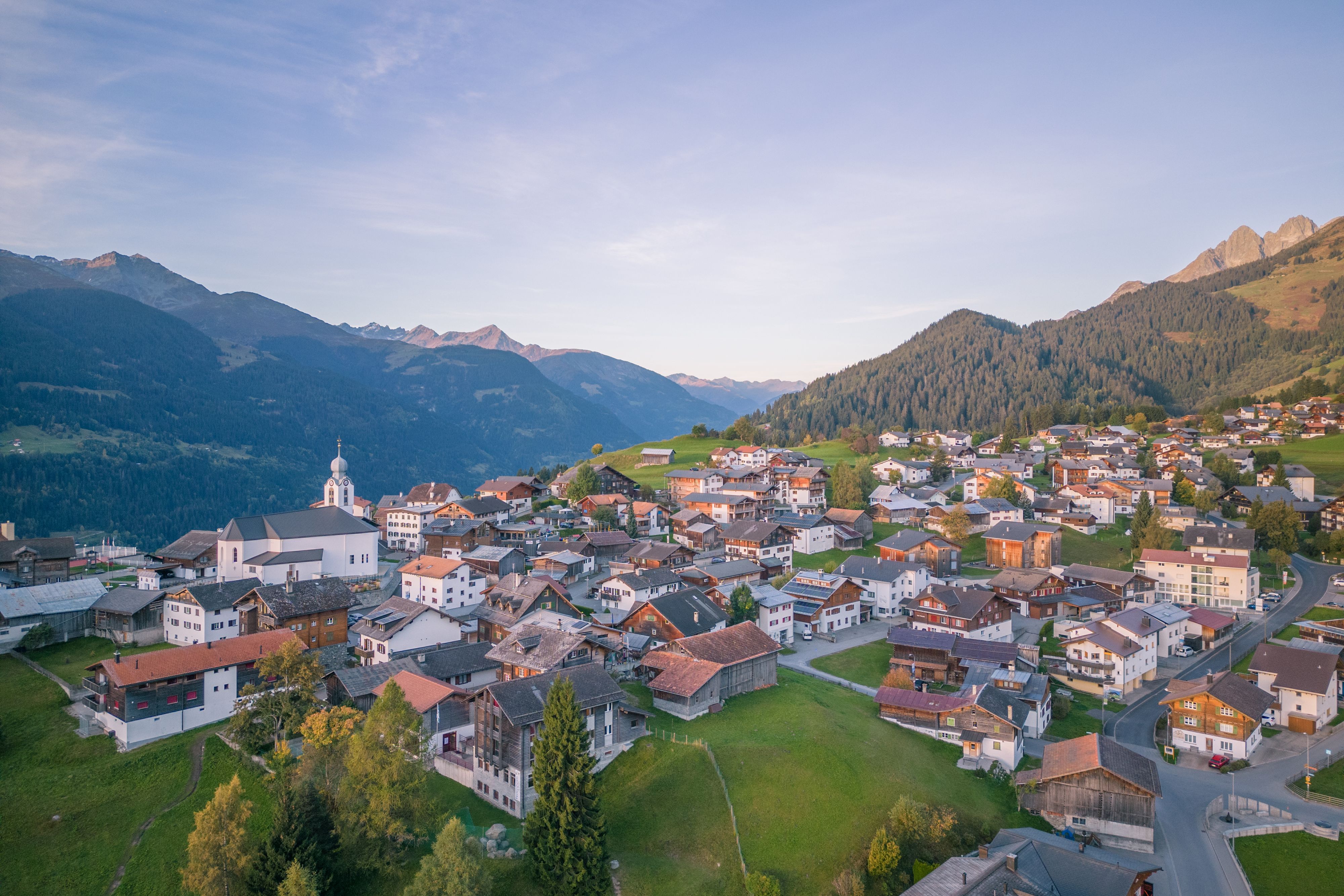
Official surveys, land register and public-law restrictions on land ownership, abbreviated PLR – these are all cumbersome terms that sound very bureaucratic. But what’s at stake is the foundation of our land ownership security – and thus part of our democracy. We’re talking about the Swiss cadastral system. Whether buying a house, building a garden fence or planning a new road – the cadastral system makes it clear what belongs to whom and which laws apply and where.
Many people are not aware that the cadastral system affects us all in our everyday lives.
But how does it really work? Christoph Käser, Head of Official Surveys and PLR Cadastre at swisstopo, explains: “The Swiss cadastral system comprises the following pillars: official surveys, register of public-law restrictions on land ownership, land register, and utility cadastre.” The official survey gathers the geodata in order to establish changes to plot boundaries, buildings and other properties. It is subject to an updating obligation, as spatial circumstances changed continuously. These data constitute part of the land register, which documents ownership as well as rights and burdens such as rights of way and mortgages. Today, it is kept primarily in digital form but also exists on paper. In addition, the information in the land register is partially public and can be inspected without the person having to justify their interest. But there are exceptions, depending on the canton: according to Käser, anyone in the public sphere such as politicians or managers can request that their names and other details not be listed in the public section of the land register.
A system that is one-of-a-kind worldwide
The register of public-law restrictions on land ownership also shows which building regulations, watercourse protection lines or other public-law regulations apply to a plot of land. In turn, the utility cadastre lists subterranean and above-ground infrastructure such as water, electricity or gas lines. Anyone wishing to build a house can inspect the PLR cadastre for the applicable regulations, can clarify the ownership situation in the land register and, with the utility cadastre, can thus avoid costly losses during the construction work. Together, these pillars form a system that guarantees legal certainty, protects ownership and creates transparency and planning certainty. “The information in the cadastral system is official and binding”, Christoph Käser explains. In other words, the state guarantees ownership security and is liable for losses arising from incorrect cadastral information.
Käser says that the Swiss system is one-of-a-kind worldwide. Many other countries have a land register but it is usually only used for tax-related purposes and not to establish ownership. This can lead to absurd situations: owners sometimes have to go to great lengths to prove that their plot of land is really theirs. In Switzerland? Unthinkable.
Trust and stability
The Swiss cadastral system is also essential for business: it establishes and documents ownership rights and mortgage loans – in 2022 these amounted to over CHF 1,141 billion. It therefore creates transparency on the property market and provides a basis for investments. Companies and private individuals can use reliable data to plan, secure financing and carry out construction projects. The cadastral system thus makes a major contribution to the stability and development of Switzerland’s economy.
Additional content
The history of the cadastral system: From Theodolite to Satellite Measurement
From the first cadastral maps in the 17th century to satellite measurement: Swiss surveying techniques have continually evolved over time. Today, they provide data with centimetre-level precision and will soon make it possible to create three-dimensional models.
Cadastral system of Switzerland
The Swiss cadastral system comprises three pillars: the cadastral surveying, the Cadastre of public-law restrictions on landownership (PLR Cadastre) and the land register.
Securing land ownership and creating legal certainty
This content is only available in French, German or Italian.
Folio 2025 – For a safe Switzerland
Security extends far beyond the military sphere. It encompasses issues such as the prevention of natural hazards, the sustainable management and supply of resources, the protection of property rights, the stability of infrastructure and the provision of information to the public. Geodata plays a key role in all these areas.