

swissEO NDVIz
The anomaly of the "Normalized Difference Vegetation Index" (NDVI) indicates the health status of forest areas, derived from satellite data.
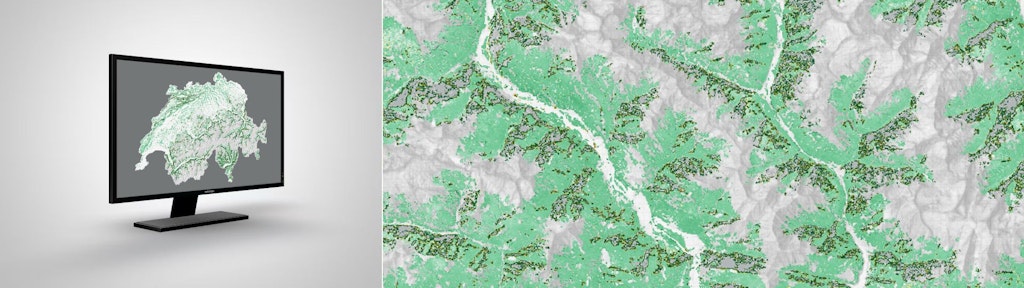
NDVI anomalies provide insights into changes in vegetation vitality because the NDVI reflects the chlorophyll content (the “green”) of plants. Chlorophyll absorbs red light, as this wavelength is used for photosynthesis. The healthier and usually greener the plant, the higher its chlorophyll content and the stronger its absorption of red light. Healthy plants, on the other hand, reflect a larger portion of near-infrared light than stressed or diseased plants do.
From the ratio of red to near-infrared light, the NDVI can be calculated — it is higher for healthy plants than for stressed ones.
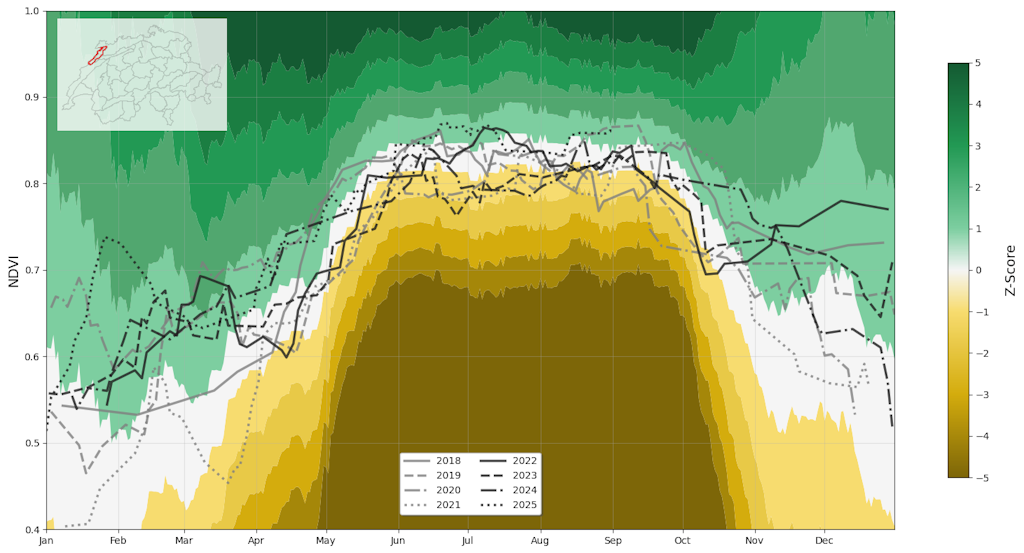
For practical use, the measured NDVI values are statistically classified. The current NDVI values are compared to the median value of the climate reference period from 1991 to 2020. The Z-score measures how far the current value deviates from the mean (or, in this case, the median). The larger the Z-score, the more extreme the deviation — and the rarer such a value is.
A positive Z-score indicates particularly vital vegetation showing growth and/or increased productivity. For example, a Z-score of +2 means that vegetation is more vital than in 95% of the comparison years.
A negative Z-score, on the other hand, indicates reduced vitality caused by management and/or natural disturbances (storm damage, drought, insect infestations, etc.). Thus, a negative Z-score may reflect either logging or premature autumn coloration.
Data representation and availability
The current dataset can be viewed in the BGDI map viewer via: https://map.geo.admin.ch/?layers=ch.swisstopo.swisseo_ndvi_z_v100 . In the BGDI WMS the dataset can be displayed by using the layer «ch.swisstopo.swisseo_ndvi_z_v100» .
To display older datasets in the BGDI map viewer, URL parameterization is required. Replace in the following link with the end date of data acquisition in the format yyyy-mm-ddT235959 (example: 2023-09-30T235959):
Example for the dataset of August/September 2023:
Further information
Access to raw data
The data can be accessed via the STAC Collection «ch.swisstopo.swisseo_vhi_v100» in the STAC interface of BGDI:
- Browser and download interface: swissEO NDVIz: NDVI anomaly (admin.ch)
- Download API documentation: REST Interface: Spatial Temporal Asset Catalog API (admin.ch)
- Google Earth Engine: VHI Image Collection (since April 2017) [projects/satromo-prod/assets/col/VHI_SWISS] / VHI Image Collection (1991-2020) [projects/satromo-prod/assets/col/VHI_HIST_SWISS]
- Accessing STAC via Python - Introduction (Jupyter Notebook)
- Image processing using Python with STAC (Jupyter Notebook)
- Streaming swissEO products in QGIS
Terms of use
swissEO may be used, distributed and made accessible. Furthermore,it may be enriched and processed and also used commercially. A reference to the source is mandatory. In the case of digital or analogue representations and publications, as well as in the case of dissemination, the following source references must be attached in any case:
© swisstopo, Contains modified Copernicus Sentinel data [Year]
Further information on the terms of use can be found on the terms of use webpage.
Index
Federal Office of Topography swisstopo
Seftigenstrasse 264
3084 Wabern