

Geodetic reference frames
The link between the coordinate reference system and the real world is provided by the reference frame. The latter comprises hundreds of points materialized in the field (e.g. by boundary markers or permanent GNSS stations), measured and their coordinates estimated. The coordinates of these points are made available to the users to access the reference frame. The reference frame is thus made available to all interested parties. These reference frames are useful for surveying, but also as a basis for geographic information systems (GIS) and all navigation systems, whether installed in cars, aircraft or vessels, or integrated into smartphones and wearable devices.
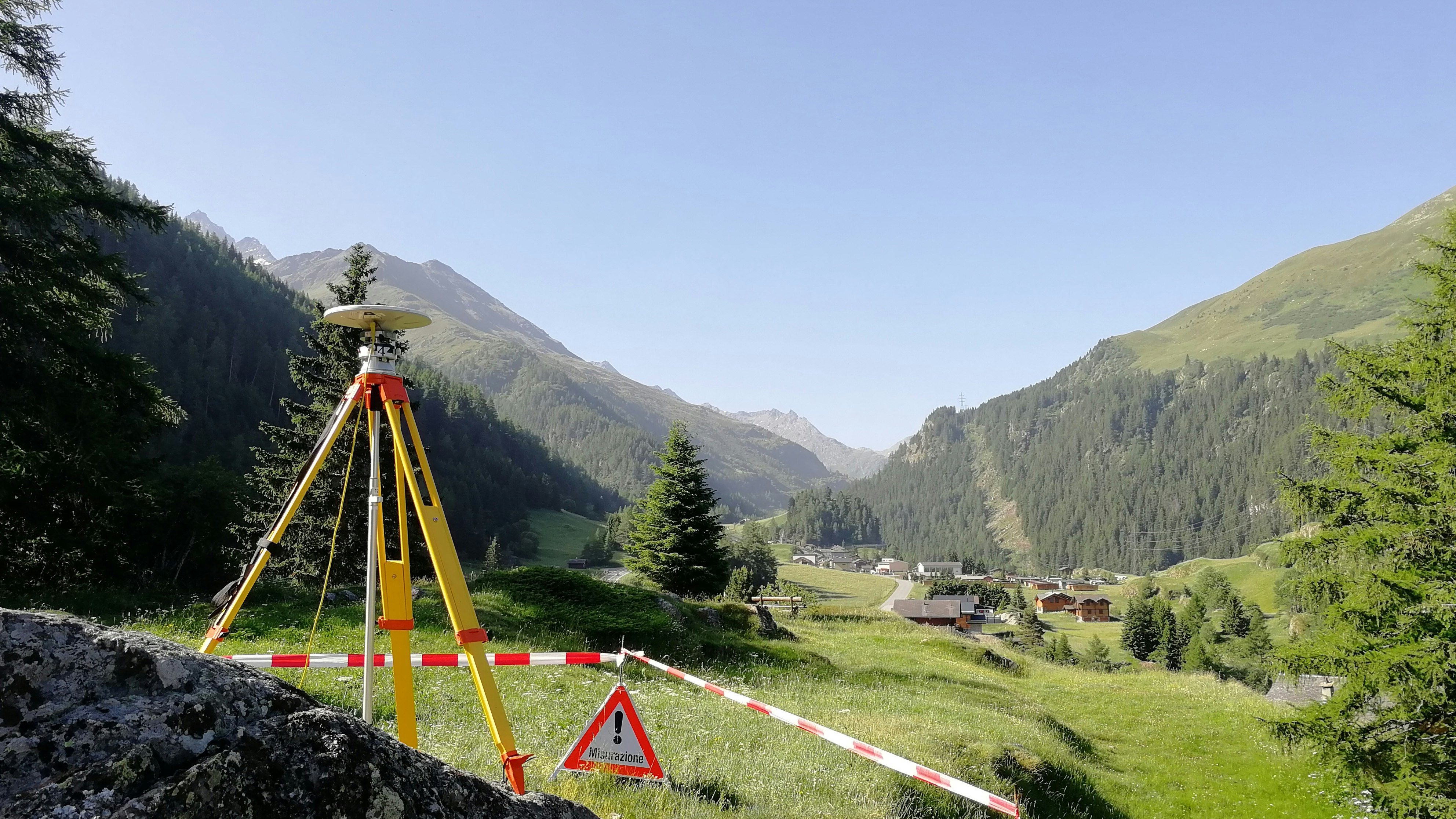
Local reference frames - Switzerland
Switzerland has hundreds of fixed surveying points distributed across its entire territory. Their positions and/or altitudes have been precisely measured and defined as coordinates. These fixed points establish the link between the reference system, with its coordinate system and cartographic projection, and the terrain. Taken together, the fixed points form the reference frame for all surveys carried out in Switzerland. Maps and plans are based on these georeferenced points.
A reference frame is an essential basic infrastructure for a country. Many services offered by the public and private sectors rely on it. In Switzerland, swisstopo manages and maintains the official reference frame, consisting of the planimetric reference frame LV95 and the altimetric reference frame LN02.
Official swiss seference frame for position and elevation
- LV95 - National survey 1995 (official reference frame)
- LN02 - National levelling 1902 (official altimetric reference frame)
- LHN95 - National height network 1995 (altimetric reference frame for scientific purposes)
Outdated reference frames
- LV03 - National survey 1903 (old reference frame)
Local reference frames - Europe
In addition to the ETRFxx reference frame (EUREF GNSS network) usable across Europe, national reference frames are also still in use. Local reference frames are adapted to the specific needs of a particular region (e.g. Switzerland) and are therefore only relevant to it. National geographic institutes provide information on these systems and their transformation parameters. The following are some examples of local European reference frames:
Global positioning reference frames
Unlike local systems, these reference frames rely on a worldwide network of measurement stations, thus ensuring optimal homogeneity and accuracy regardless of location on the globe. Most of them are coupled to the ITRF which also serves as the basis for different GNSS constellations:
Federal Office of Topography swisstopo
Seftigenstrasse 264
3084 Wabern