

New aerial imaging sensor – evolution and changes in swisstopo products
The acquisition of aerial images constitutes one of the essential foundations for the production of national geodata by the Federal Office of Topography swisstopo. These data are used in particular for updating the topographic landscape model, national maps, as well as for producing the SWISSIMAGE orthophoto mosaic. In order to keep pace with the rapid evolution of aerial imaging technologies and to further improve the quality and efficiency of its surveys, swisstopo is modernising its sensor system and evolving several products in its catalogue.
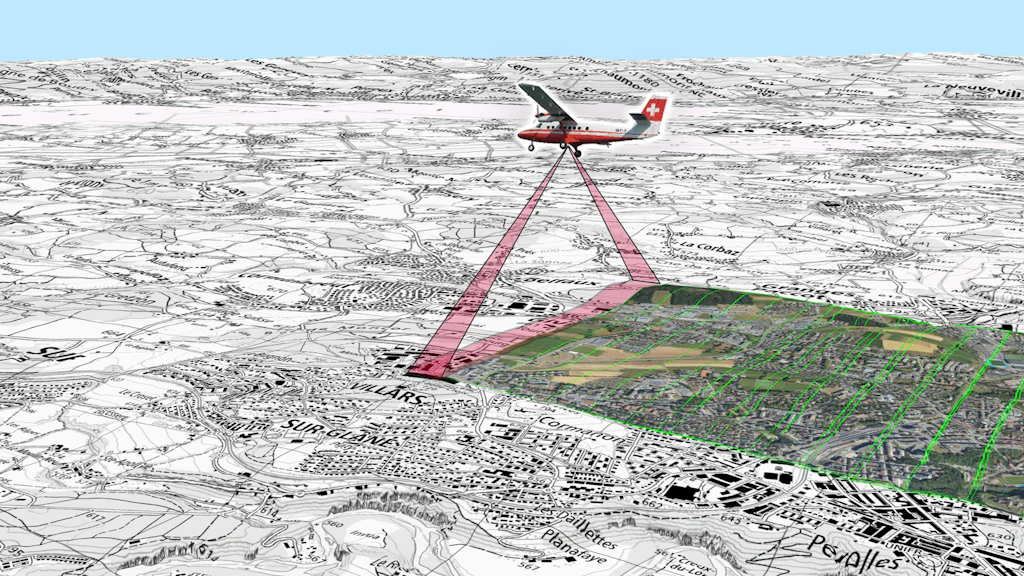
Transition from the ADS100 sensor to the DMC-4S
Since 2005, swisstopo’s aerial image acquisition campaigns have relied on linear sensors from Leica Geosystems. In recent years, the ADS100 model was in operation. These sensors operate according to the “pushbroom scanning” principle, in which a line of pixels scans the ground as the aircraft moves, producing long image strips that can reach several tens of kilometres. Recent technological developments have led manufacturers to abandon this type of sensor.
Acquisition is now based on two next-generation Leica DMC-4S frame sensors. This technological evolution brings a significant change: whereas the ADS100 produces continuous image strips, the DMC-4S captures individual conventional images, which are easier to use. The new sensor also offers greater flexibility in flight planning and makes it possible to optimise aircraft deployment. Furthermore it entails the implementation of a new aerial image processing chain at swisstopo, which will ultimately be more efficient than the previous one.
Learn more: Switzerland in high resolution
Evolution of the SWISSIMAGE product
The characteristics of the new sensor enable swisstopo to evolve the SWISSIMAGE product and better meet user needs. The first regions to benefit from this will be available in autumn 2026. The main developments are outlined below.
A perfectly vertical view everywhere
From 2026 onwards, SWISSIMAGE becomes a True Orthophoto. The new orthophotos are now fully corrected for geometric distortions, including those caused by objects above the ground. The change is most striking in buildings: each structure is shown in true orthographic projection, without any lateral displacement or distortion that would obscure adjacent streets.
The generation of a True Orthophoto is made possible by a high overlap of aerial images: each portion of the terrain is photographed at least 10 times from different angles. This overlap makes it possible to create a highly detailed Digital Surface Model (DSM), representing both the topography and objects on the ground. The True Orthophoto is then produced by combining this DSM with all captured images: each pixel in the final image is corrected to account for surface geometry, ensuring a faithful and distortion-free representation.

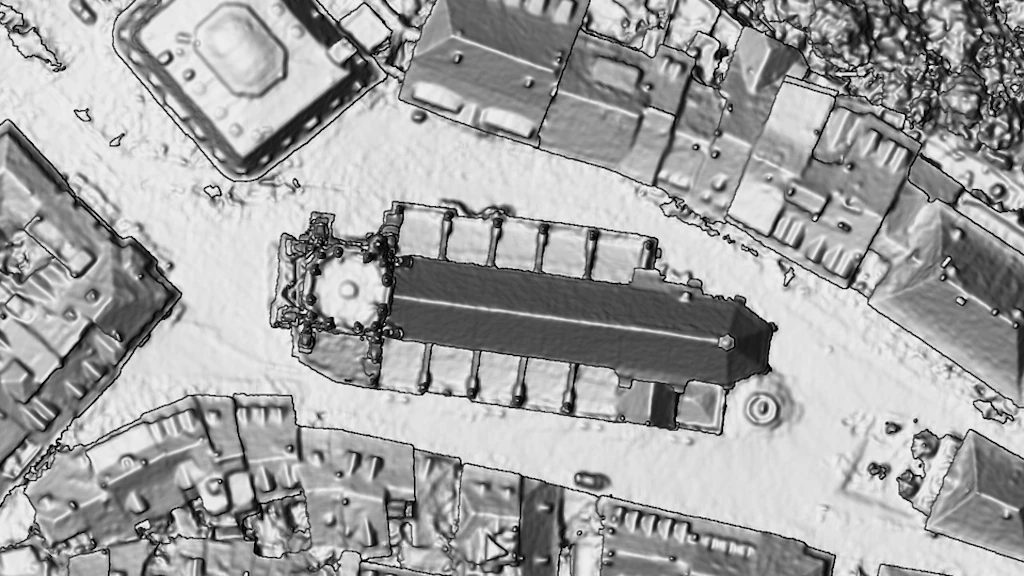
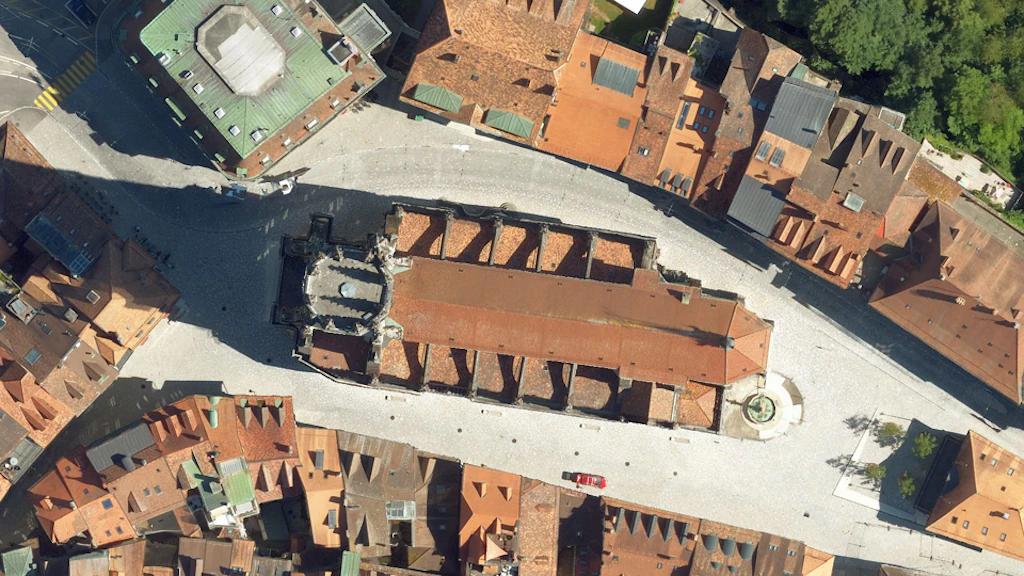
Near-infrared included
The new generation of the product will be provided as kilometre-based tiles of an 8-bit RGBN True Orthophoto mosaic, combining the red, green, blue and near-infrared spectral bands.
Higher resolution in the Alps
In the Alps, the original orthophoto resolution has been improved from 25 cm to 20 cm, providing an even more detailed representation of terrain and objects.
Discontinuation of certain products
With this technological evolution, some products are reaching the end of their production cycle.
The SWISSIMAGE RS product will no longer be produced. Specialist users will now find the near-infrared channel directly in the new RGBN orthophotos derived from the DMC-4S sensor.
Similarly, the aerial image strip product – corresponding to the linear image strips acquired by ADS sensors – will be progressively replaced by digital aerial images from the new frame system.
ADS image strips were used as base data for photogrammetry and for producing derived products such as SWISSIMAGE or terrain models. The new generation of aerial images will offer the same possibilities while integrating better into modern processing workflows.
Continuity and improvement of national geodata
These developments are part of swisstopo’s strategy to maintain a high level of quality and currency of national geodata.
Thanks to the introduction of the DMC-4S sensor and the modernisation of the SWISSIMAGE product, users – public authorities, companies, researchers and the general public – will benefit from even more accurate data, better suited to current applications such as 3D modelling, environmental analysis or spatial planning.
Test data
These data are made freely available to carry out tests and become familiar with the new data types. Changes are still possible until the final products are released.
Available data:
- 2 True Orthophoto Tiles of Fribourg Cathedral in 4 channels (RGBN)
- 12 Aerial images (.tif) of Fribourg Cathedral with orientation and calibration elements (.gori)