How can an endless volume of transport network data from different sources be combined with the most diverse views of the transport network? Two steps are needed: How do you combine countless transport network data from different sources and with different perspectives of the transport network? First, the tools provided by Transportation Network CH are used to find a common reference for the existing data so that it can be linked together in the next step.
Linking data without changing it
Anyone who plans, implements, operates or uses transport routes and infrastructures in the public and private sector needs up-to-date and reliable transport network data, e.g. road and railway infrastructure inventories, data for traffic planning and modelling, traffic accident statistics, noise and emissions calculations, and network data from private providers.
A large amount of this data is already available in high quality. However, it is often difficult or impossible to link it together. There is currently no overarching coordination, which means that the potential uses of much of this data are not being exploited.
Different information is important for each application in the mobility sector. As a result, the transport infrastructure and its characteristics are represented differently by various data sets. Furthermore, the data is not recorded or updated centrally. It is dispersed across all levels of government as well as in private organisations and can vary greatly in terms of scope and structure. This makes it difficult to combine the data.
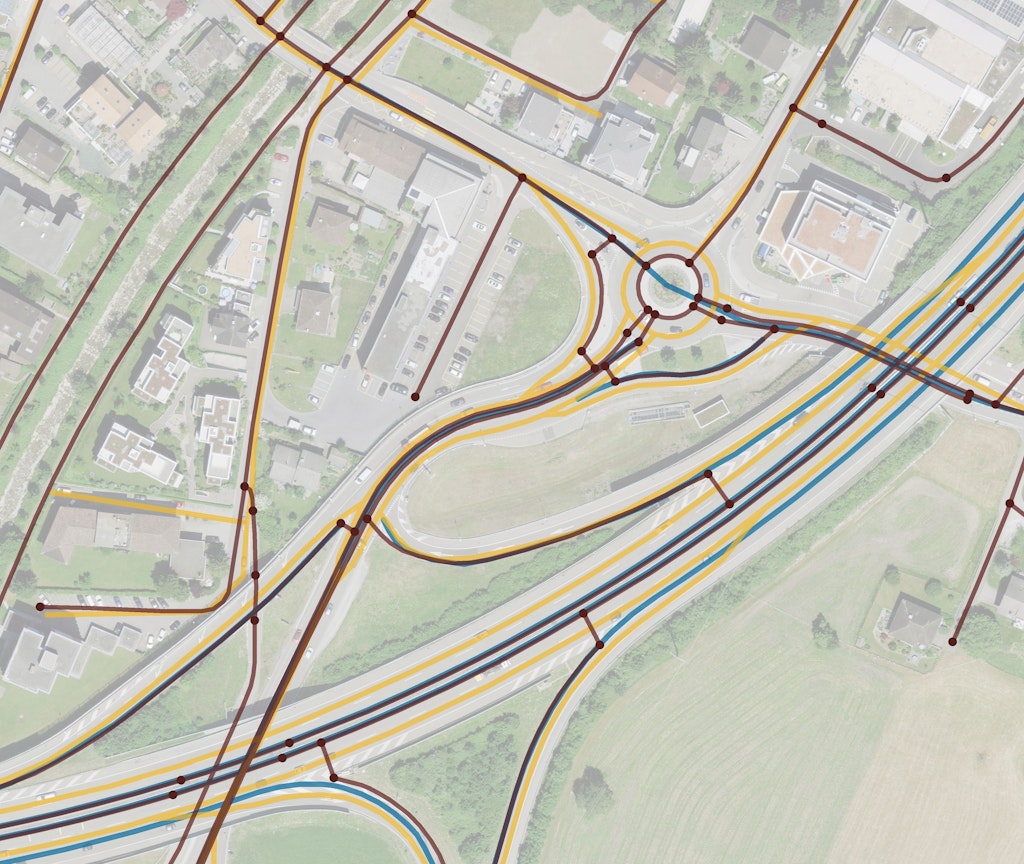
The figure shows three data sets and how differently they represent the physical transport network and its characteristics: data from the FEDRO spatial reference system (RBBS, blue), the ARE national passenger transport model (NPVM, yellow) and the swisstopo topographic landscape model (swissTLM3D, brown)
As there is no general network as a basis, it is often not possible to automatically determine whether the information from different data sets relates to the same location. Time-consuming manual corrections are required.
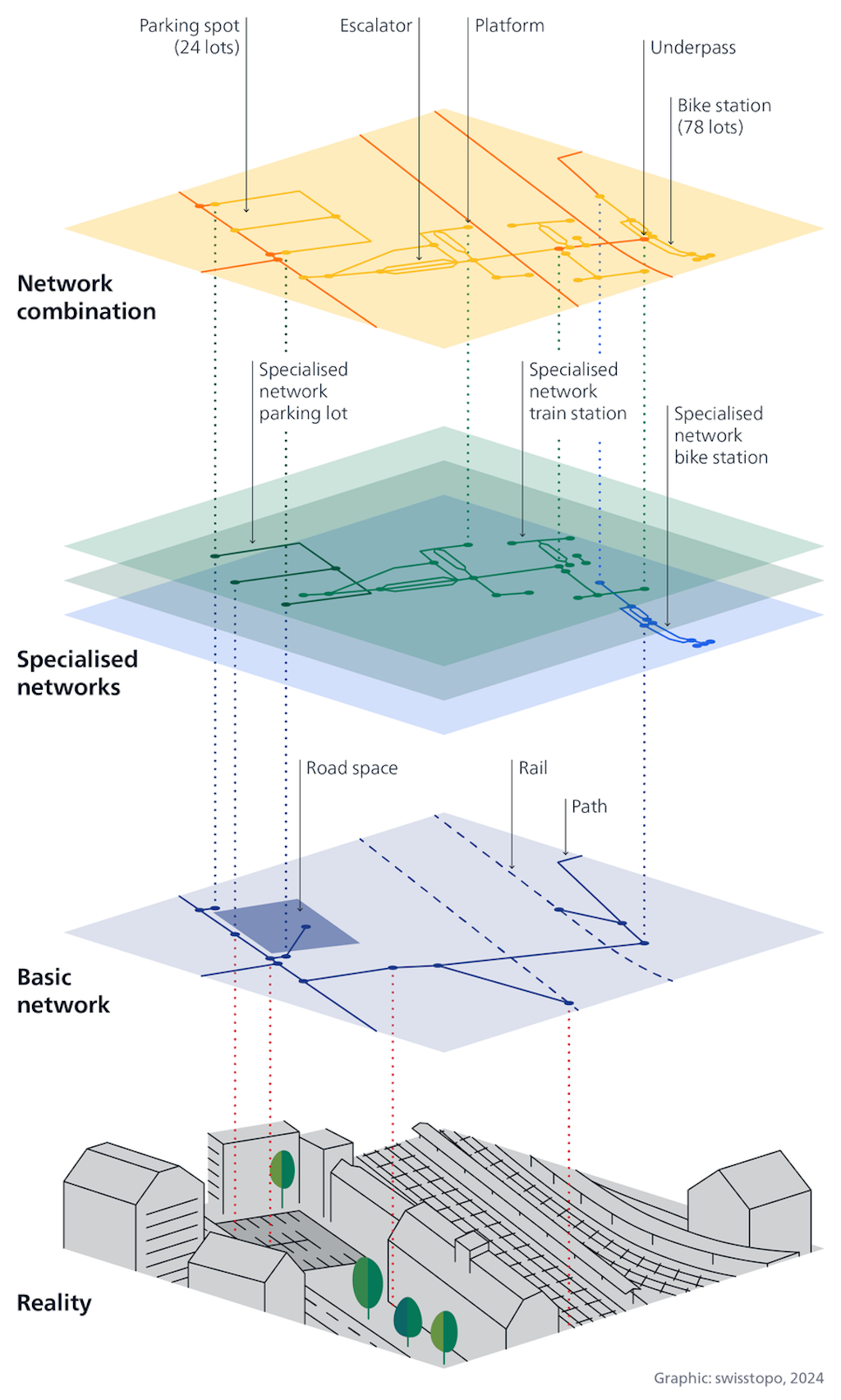
Transportation Network CH offers tools to solve this problem. First, users must reference (match) the available data to a common basis (basic network). Then it can be combined with other information that has also been matched to the base network.
First referencing, then combining
With the functions provided by Transportation Network CH, objects from a data set A can be assigned efficiently and automatically to the objects in a data set B. The basic network acts as a connecting element. This approach preserves existing networks and their basic structure does not need to be changed.
This allows users to combine spatially locatable information on modes of transport (roads, railways, waterways, cableways) and their use, and to use them in combination. This applies regardless of whether the data is from the federal government, cantons, municipalities or private individuals, and regardless of the geodata basis on which it is built. In doing so, they can use all data that belongs to them, that they are allowed to use (e.g. through a purchased licence) or that is freely accessible.
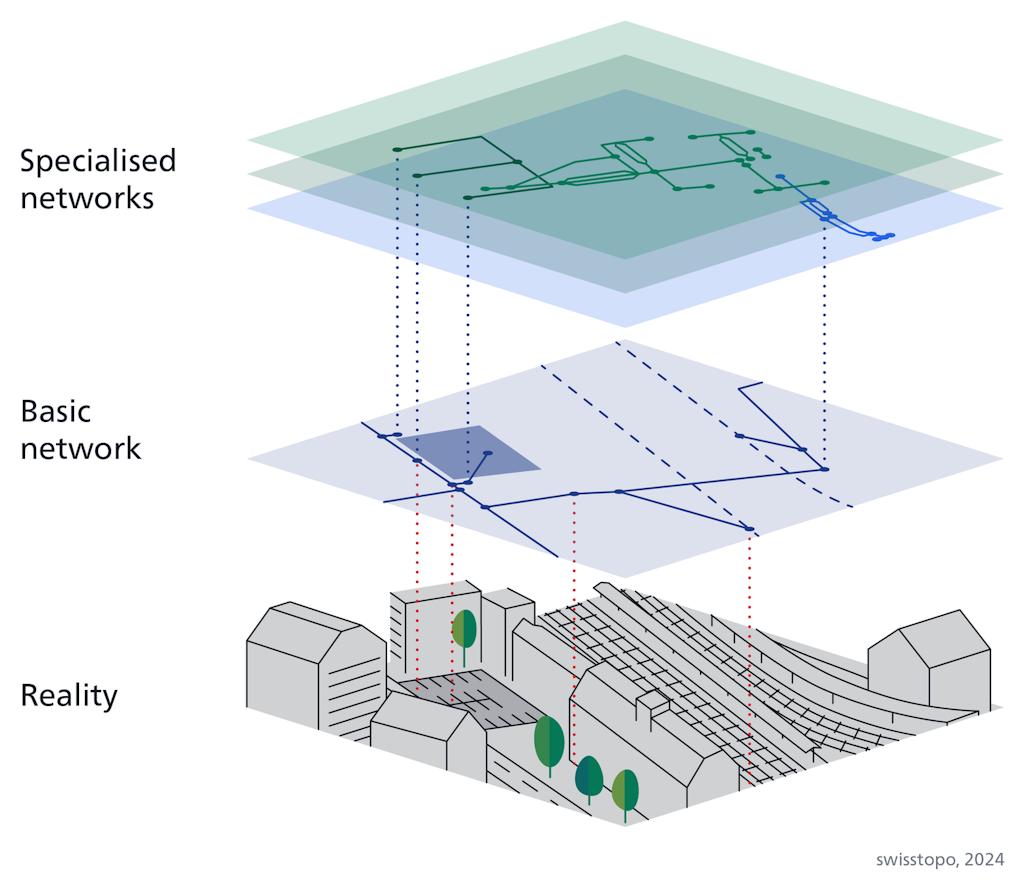
In a first step, users take the Transportation Network CH tools and create specialised networks by referencing the desired mobility data to a common basic network. This referencing allows data from different sources to then be combined in a second step (network combination) – even if the data is built on different geospacial data sources.
How does referencing work?
Referencing—or “matching”—specialised data to the basic network lays the foundation for the subsequent data combination. It includes the following aspects:
With the “Matcher” tool, specialised data of different geometries (edge networks, nodes and areas) can be located in the basic network. First, the various objects are assigned, e.g. which road section in the specialised data set corresponds to which road section in the basic network.
To do this, users select which parts of their data should be matched to the basic network (e.g. only roads with the attribute “Motorway” or only objects in a specific area) and which matching method (which algorithm) they would like to use. In this way, the most probable matching partner in the basic network is determined for each individual object in a specialised network.
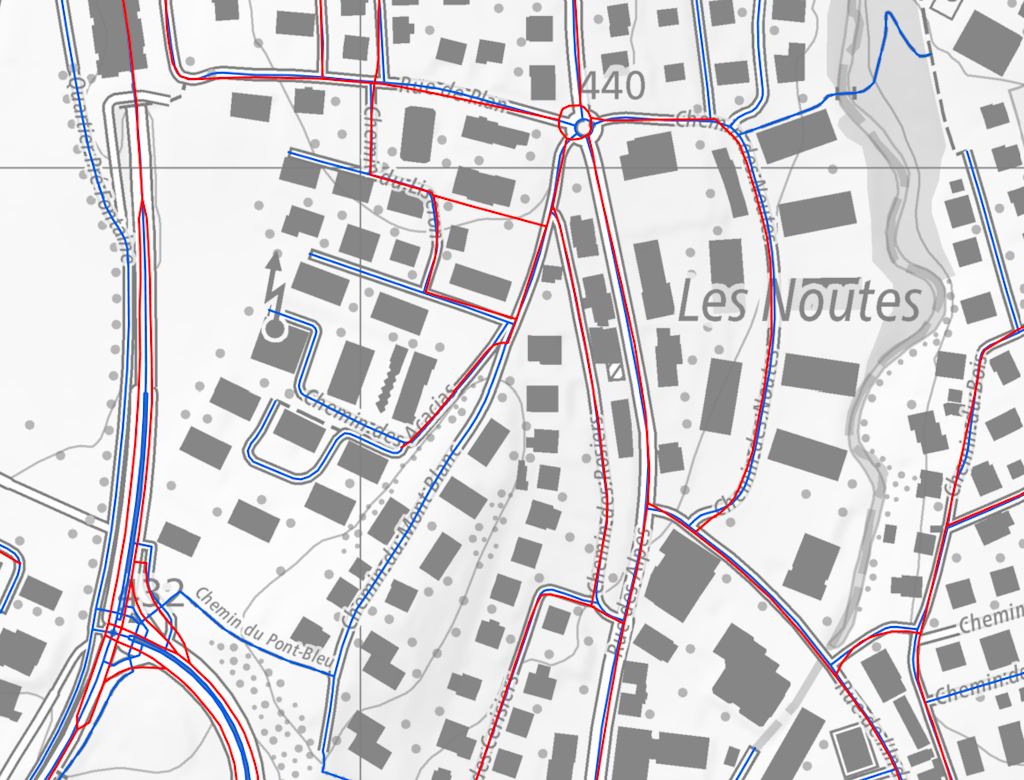
Basic network (blue) and the data set for the national passenger transport model NPVM (red). During matching, every piece of information from the specialised data set is assigned to the basic network.
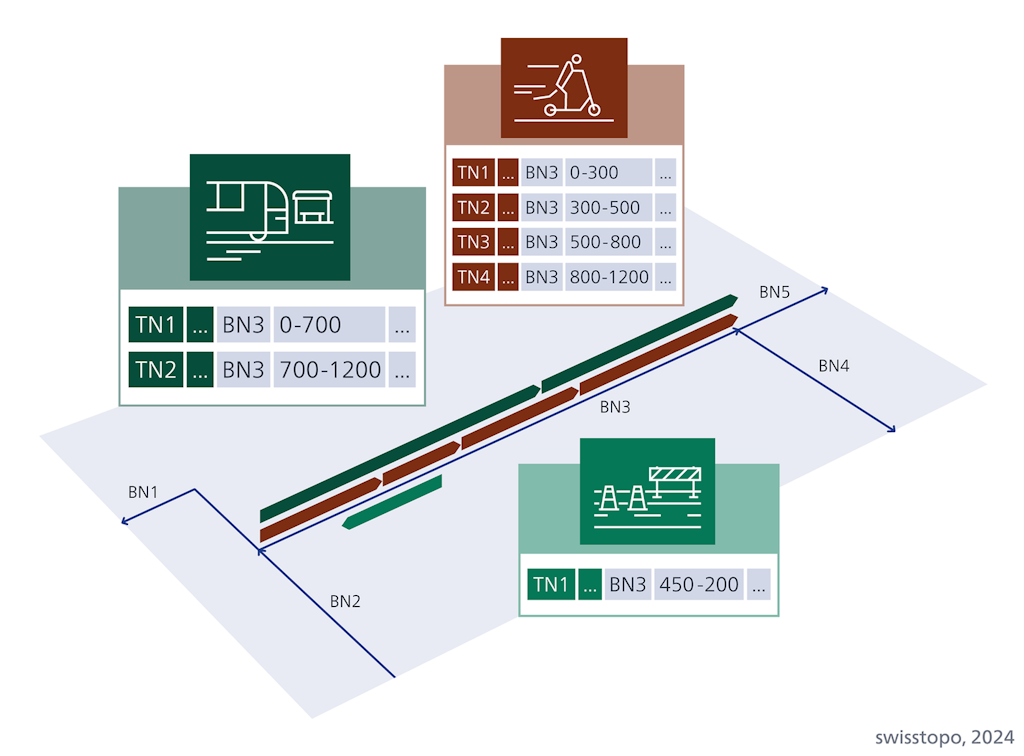
If the specialised data objects are assigned to an edge (or alternatively to a node or area) in the basic network, linear referencing of these objects to the basic network takes place. This means the exact position of each specialised data object (e.g. a bicycle path, tram connection or construction site) on this edge (or node or area) is defined in the basic network. The information is entered “from metre”, “to metre”. This referencing to the basic network ensures that corresponding specialised networks are created for the specialised data sets.
The diagram shows how three different specialised networks (TN) are assigned to an edge in the basic network (BN), including their linear positioning. For example, a tram line (TN 1, dark green) runs from metre 0 to metre 700 on the basic network edge BN 3.
Geometric and topological matching
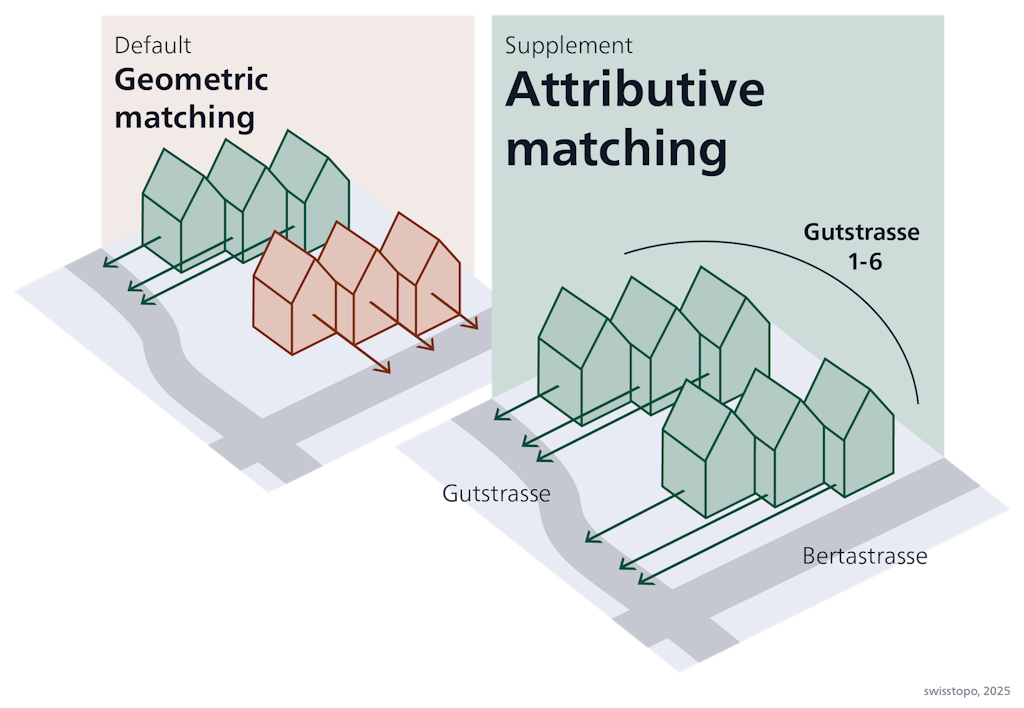
Geometric matching spatially aligns objects from a specialised data set (e.g. roads, public transport stops, speed zones) with the corresponding objects in the basic network. This is based solely on the geometric shape and position of the objects. Some of the algorithms offered also consider the topology of the network, i.e. the spatial relationships between the objects (e.g. connections, neighbouring objects, routes). Depending on the use case, either one or a combination of several offered algorithms may be suitable. If a combination is used, it is empirically determined which algorithm is best suited for each edge/node/area.
Attributive matching
Attributive matching involves comparing properties (semantic information), which can improve geometric matching. For example, users can specify that the matching with the basic network should be carried out using street names or categories such as “Motorways”. This allows certain combinations to be excluded, or rather, there are fewer objects in the base network per specialised data object that they could match with. This makes the assignment more accurate. However, this requires that certain specialised information referenced to the basic network is already available, which contributes these attributes (e.g. street names or categories). The basic network itself does not contain any specialised information. The more specialist network data is available in verified quality in the future, the more accurate attributive matching will become. And with each additionally referenced piece of specialised information, the possibilities for attributive matching increase further – provided that the data is also integrated in the Transportation Network CH data management system.
Example: A building has the address Gutstrasse 6, but is closer to Bertastrasse. With geometric matching only, it would be assigned to the street to which it is closest. If a user determines that the attribute “Street name” should be considered during matching, the assignment is made correctly.
The key result of the matching process is the linear referencing of the specialised data to the basic network.
These relationships are provided to users for download as a linear referencing table.
GIS data for QGIS and ArcGIS is supplied for visualising the matching. This contains the results (specialised network) referenced to the basic network, the original specialised data and the original basic network data. Thanks to the preset view, all data can be displayed clearly and shown or hidden as layers.
A matching report summarises the most important additional information. For example, it lists all the elements that need to be reworked manually. For these elements, it was not possible to establish a sufficiently probable assignment in the basic network with the selected matching settings.
Users who wish to make their matched data publicly available as a specialised network via Transportation Network CH can do so using the “Configurator” tool. Here, they specify, for example, which attributes their specialised network should have, which metadata it contains (e.g. who created the data) and who can edit and use the specialised network.
Making the specialised networks publicly or partially publicly available facilitates, for example, the exchange of data between organisations or authorities, adds value to the data that has already been collected and data combinations that have been created, and eliminates the need to collect data multiple times.
[NR1]Can klingt, als ob die Metadatenpflege und Attributdefinition optional sein wird. Aber sie müssen es ja machen.
[NR2]Satz nicht falsch, aber schwierig zu durchschauen.
How does combining work?
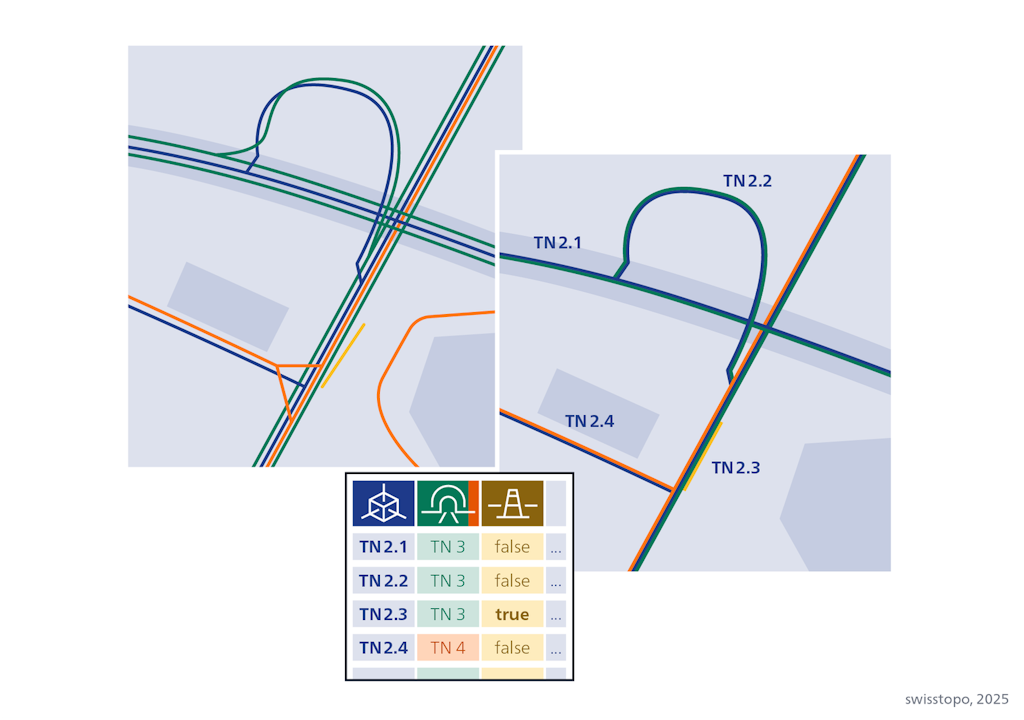
After referencing to the basic network, users can combine several specialised networks with a wide range of geometries using the “Combiner” tool. In this way, the objects within the specialised networks can be assigned directly to the corresponding objects of the other specialised networks via the references in the basic network. The geometry can be adopted either from a specialised data set or from the basic network. Users establish a set of rules in advance that specify how they want to combine the networks.
— Example: A user wants to combine the specialised networks TN 3 (green) and TN 4 (orange and yellow). Both specialised networks provide information about height restrictions on a road. Specialised network 4 also contains information on construction sites. The user has defined beforehand in the set of rules that the basic network determines the geometry of the combined network. They also know that TN 3 contains better information and therefore identify it as the priority data source. If no data is available from TN 3 (as in section TN 2.4), data from TN 4 should be used. This gives them exactly the data combination that best suits their purposes.
The generated network combinations can also be published as separate specialised networks and/or made available for general use.
This function will be added later. A wide range of filter and aggregation functions are planned for the final version to enable a wide range of questions to be answered using the data.
Basic network
The basic network is a fundamental element for the spatial linking of transport infrastructure and mobility data. It provides a digital map of the physical transport network and comprises all roads/paths, railways, waterways and cableways in Switzerland and Liechtenstein. It contains only a minimum of information. It thus provides the lowest common denominator and a geodata basis for referencing with other data.
The basic network is already available for download as the freely accessible swisstopo product swissTNE Base. It is currently based mainly on swisstopo’s topographic landscape model (swissTLM3D). The data therefore meets a high-quality standard.
The project team is constantly developing and expanding the basic network. It is currently updated annually; in the medium term, updates are to be made [NR2] continuously and the data will be dynamically accessible. It is planned to include data from neighbouring countries in the future. Thanks to the sequential (incremental) updates and change history, changes to the basic network are fully traceable.
The transport routes and transfer connections between the modes of transport are multimodally linked in the basic network and represented in a simple geometric and topological edge-node model: The nodes show the intersection points within a mode of transport as well as the transfer points between the modes of transport. The edges connect the nodes and represent the roads, railways, cableways and waterways.
If edges intersect at different levels (e.g. if there are bridges), no node is created. Areas where free movement is possible (e.g. public squares or lakes) are also represented as nodes. They can have an additional area geometry defining the space in which free movement is possible.
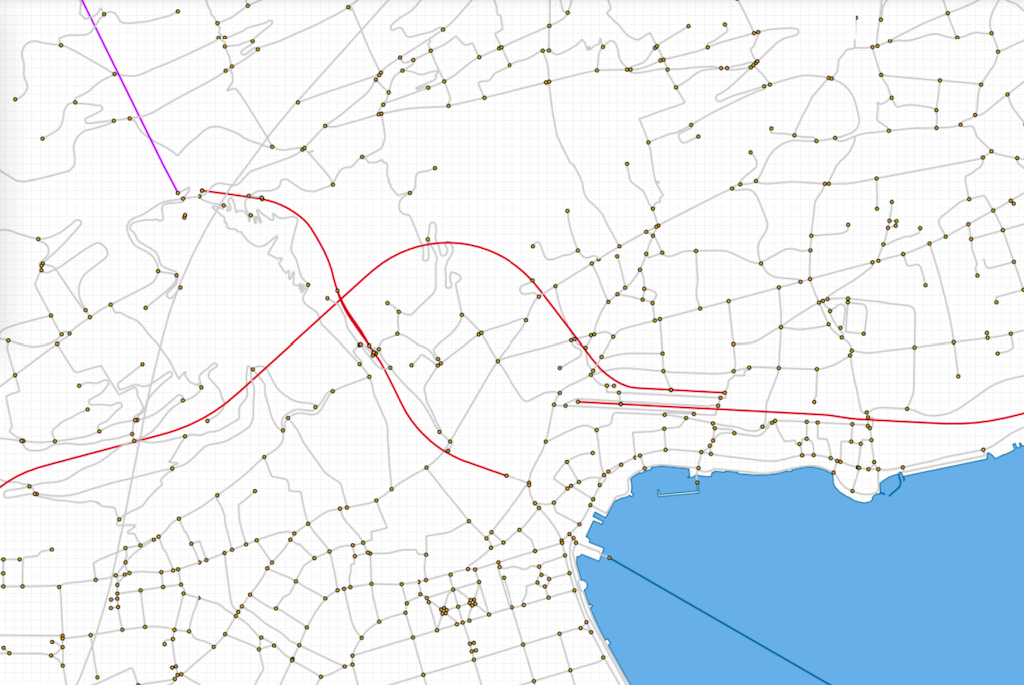
The basic network maps roads (grey), railways (red), waterways (blue) and cableways (purple)
The information in the basic network is deliberately kept to a minimum so that it does not become too minutely detailed and can serve as a common denominator. Specifically, the basic network only contains the following attributes:
Unique identification numbers (IDs) for each object that remain stable over time
Geometry (information on the position), for linear objects additional alignment information, for area objects additional area information, all specified in three-dimensional space
Information about the mode of transport (road, railway, cableway, waterway)
Relationships between the objects (e.g. here, two roads meet at an intersection, or here, one road crosses another, but they are not connected, as in the case of a bridge)
— Unambiguous directions of the axes (via the reference to the start and end nodes)
Temporal extent of the object
Data ownership and data source
Specialised information such as turn restrictions or traffic signs is included in corresponding specialised networks.
Specialised networks
Specialised networks contain specific information on the physical transport network and/or the mobility that takes place on it. This can be geometric details (e.g. the exact course of the road, the exact shape of an area) or detailed information (e.g. clearance heights, turn restrictions, accident statistics).
The data content of specialised networks can come from individual sources or be combined from multiple sources, and can be provided and published centrally (by Transportation Network CH) or decentrally (by users). Responsibility for the data content remains with the original data source, i.e. federal offices, cantons, municipalities, transport companies or private individuals.
What all specialised networks of the Transportation Network CH have in common is that they are referenced to the basic network and can therefore be linked to other mobility data.
Some specialised networks are of general interest or are essential for the functions of Transportation Network CH. As a result, certain attributes make it easier to reference specialised data to the basic network (e.g. addresses, street names, street categories, number of lanes or track gauges). Other information, such as traffic restrictions or transfer points, is an important basis for the priority use cases of the MODI. For this reason, Transportation Network CH will provide some specialised networks itself in the future and make them accessible to all users.
In a first step, Transportation Network CH will provide the “vessels” (including data models) and tools for linking these specialised networks. The specialised networks are filled incrementally with data content, in collaboration with the responsible specialist organisations, tailored to the prioritised use cases of the MODI and depending on the availability and accessibility of the data. Swisstopo (Transportation Network CH) and the competence centre for mobility data (FOT/KOMODA, responsible for operating the MODI) play a coordinating role here.
Examples of the possible main specialised networks of Transportation Network CH:
Roads and paths: All roads and paths in Switzerland in the form of edges and nodes, including information on type, class, width, etc.
Rail network: Tracks and lines, including network nodes and edges, chainage, track characteristics
Addresses: Municipalities, streets, building numbers
The main specialised networks are added when there is a need due to use cases.
There are currently no third-party specialised networks available yet for public use. This should also be possible in the future.
Users will then be able to use the Transportation Network CH tools to set up their own specialised networks and use them for their own purposes. They can also decide whether to make their specialised networks available to other users via Transportation Network CH. Responsibility for the data content always remains with the original owners.
Organisation of Transportation Network CH
In addition to specialised components, Transportation Network CH also contains organisational components. For example, the project team is developing rules and processes that enable collaboration with the systems and data from a wide range of organisations.
In order to make the Transportation Network CH system available in a reliable manner, a central organisational unit is required for the operating phase. This unit is responsible for:
Overall coordination
Operation and further development of the required IT infrastructure
Availability of technical and organisational functions
Provision of fundamentally important content (basic network and specialised networks central)
Easy submission and use of data by third parties
Provision of appropriate tools and interfaces and ensuring their quality
Professional and technical support
In the current implementation phase and the prior initiation, swisstopo defined the tasks of the organisational unit and has already prepared many of them. The MODIG bill therefore recommends that swisstopo continue to take on these duties.
Swisstopo or the subsequent organisational unit is not responsible for the topicality and quality of the specialised network data. Each specialised network has clear responsibilities in terms of space and content. Responsibilities for the data content are often already regulated by existing legislation. As a rule, the data should be maintained in a decentralised manner and close to the data source. This means that infrastructure owners of the modes of transport are then well aware of the current status and the routes being planned. In addition, licensing authorities, for example, are informed of changes at a very early stage.
There are also plans to involve the public in the updating process. Among other aspects, users should be able to provide information for revisions by working with crowd-based exchange platforms or error reporting services.
A brief overview, added value, target groups and answers to the most frequently asked questions
6 February 2026
Tools and functions
Tools for adding and combining transport network data
6 February 2026
Examples of best practices
Already implemented and possible future applications of Transportation Network CH
Federal Office of Topography swisstopo
Project Team Transportation Network CH Seftigenstrasse 264 3084 Wabern
If you are interested in Transportation Network CH, have specific questions about its use, would like to provide feedback, or have ideas for a specific application, please contact our project team: